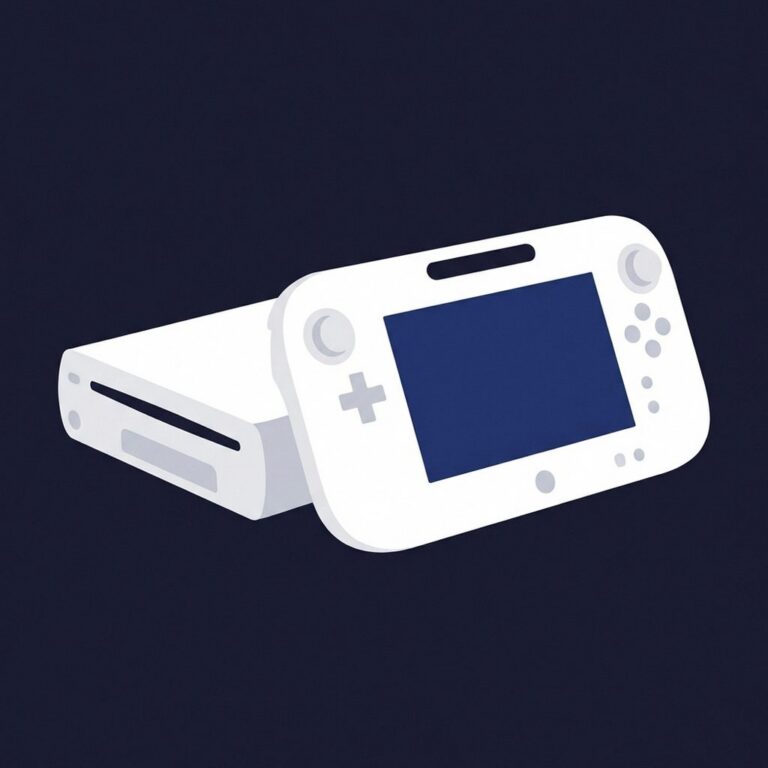
The Nintendo Wii U is Nintendo’s most significant commercial failure — and paradoxically, one of its most important consoles. Selling just 13.56 million units in a generation where competitors moved 100+ million, the Wii U seemed to prove that the Wii’s magic was a one-time phenomenon. But the Wii U’s core concept — a console with a screen-equipped controller — laid the foundation for the Nintendo Switch, which became Nintendo’s greatest success. The Wii U had to fail for the Switch to exist.
History & Development
By 2010, the Wii’s momentum had stalled. Despite selling over 100 million units, the Wii suffered from a dramatic software drought in its final years as third-party developers abandoned its underpowered hardware. Core gamers had largely moved to Xbox 360 and PS3. Nintendo needed a successor that could recapture hardcore gamers while retaining the casual audience.
The Wii U was revealed at E3 2011, and confusion began immediately. Nintendo’s presentation focused so heavily on the GamePad controller — a tablet-like device with a 6.2-inch touchscreen, dual analog sticks, and traditional buttons — that many viewers thought it was a Wii accessory rather than a new console. This confusion never fully resolved. The name “Wii U” compounded the problem — it sounded like an add-on, not a generational leap.
The Wii U launched on November 18, 2012 in North America in two configurations: a Basic set at $299 (8 GB, white) and a Deluxe set at $349 (32 GB, black, bundled with Nintendo Land). Initial sales were moderate but dropped sharply after the holiday season. By 2013, monthly sales were below 100,000 units in the US — catastrophically low for a new console.
Third-party support evaporated almost immediately. EA publicly stated the Wii U was not a priority. Ubisoft scaled back after poor sales of launch titles. By 2014, the Wii U was essentially a first-party-only platform. Nintendo discontinued it in January 2017, just weeks before the Switch launched.
Hardware & Technical Specifications
The Wii U’s hardware was a modest upgrade from the Wii — dramatically underpowered compared to the PS4 and Xbox One that launched a year later. The IBM Espresso CPU was a tri-core PowerPC processor at 1.24 GHz, and the AMD Radeon-based GPU produced approximately 176 GFLOPS — less than a tenth of the PS4’s capability. The 2 GB of RAM was split evenly between games and the operating system, leaving just 1 GB available for developers.
The GamePad was the console’s defining feature. Its touchscreen could display game content independently from the TV, enabling off-TV play — continuing your game on the controller while someone else used the television. Certain games used the second screen for maps, inventory management, or asymmetric multiplayer (where the GamePad player had a different view than TV players). The concept was genuinely innovative, but few developers outside Nintendo found compelling uses for it.
The Wii U was fully backward compatible with Wii games and accessories, including Wii Remotes, the Balance Board, and Classic Controllers. It also featured a Wii mode that essentially rebooted the console into a Wii environment.
Game Library & Legacy
The Wii U’s library of 791 games was thin by 8th-generation standards, but Nintendo’s first-party output was characteristically excellent:
Super Mario 3D World (2013) was a joyful cooperative platformer. Mario Kart 8 (2014) — widely considered the best entry in the series — sold 8.46 million copies on Wii U (and would later sell 60+ million on Switch). Super Smash Bros. for Wii U (2014) delivered the series’ largest roster to date. Splatoon (2015) was a rare entirely new Nintendo IP — a colorful team-based shooter that created a passionate community. Bayonetta 2 (2014), funded and published by Nintendo, was critically acclaimed. Xenoblade Chronicles X (2015) offered a massive open-world RPG. The Legend of Zelda: Breath of the Wild launched simultaneously on Wii U and Switch in March 2017 — though the Switch version overshadowed it entirely.
Many of the Wii U’s best games were eventually ported to Switch — Mario Kart 8 Deluxe, Super Mario 3D World + Bowser’s Fury, Donkey Kong Country: Tropical Freeze, Bayonetta 2, Pikmin 3 Deluxe, Captain Toad — where they found the audience they deserved.
Models & Variants
The Wii U came in two storage configurations: 8 GB (Basic/White) and 32 GB (Deluxe/Black). The 8 GB model was quietly discontinued due to poor sales and impractically low storage. Special edition bundles included The Legend of Zelda: The Wind Waker HD (gold GamePad), Super Mario 3D World, and Splatoon. A Super Mario Maker bundle with a special anniversary GamePad was produced in limited quantities.
Collecting & Value Today
The Wii U has become an increasingly interesting collector’s platform precisely because of its commercial failure. Low sales mean fewer units exist, and many exclusive games were never ported to Switch. A working Wii U with GamePad sells for $100-180 USD. Games like Xenoblade Chronicles X, Star Fox Zero, and Affordable Space Adventures remain Wii U exclusives. The eShop shut down in March 2023, making digital-only titles permanently unavailable — increasing the value of physical releases.
The GamePad’s battery is the primary maintenance concern — original batteries hold minimal charge after years of use, though replacement batteries are readily available. The GamePad touchscreen digitizer can develop dead spots. The console itself is reliable, with no widespread hardware failure issues.