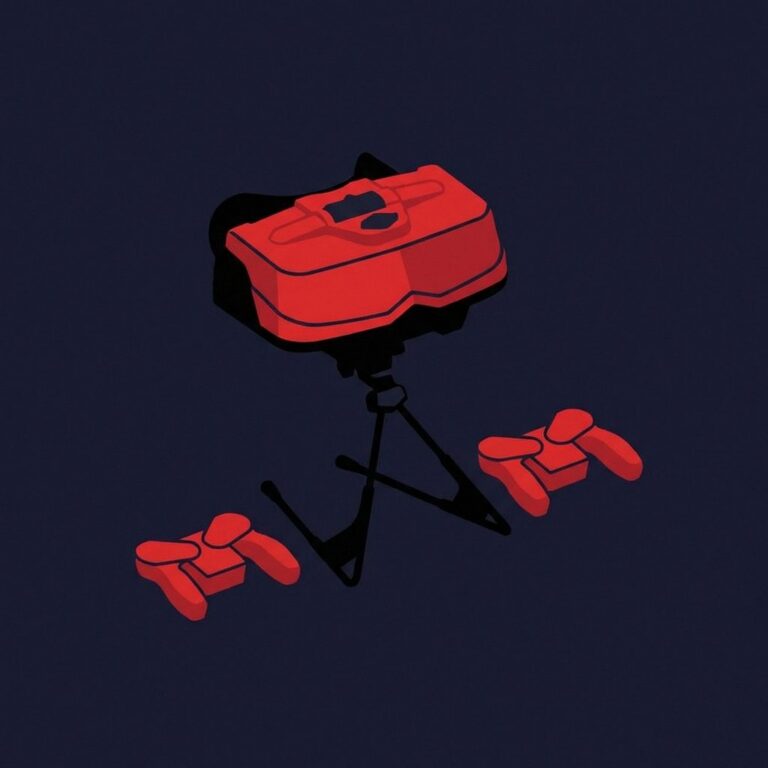
The Nintendo Virtual Boy is gaming’s most famous failure — and one of its most fascinating. Released on July 21, 1995 in Japan and August 14, 1995 in North America, it was discontinued within a year, having sold approximately 770,000 units with a total library of just 22 games. It was never released in Europe. The Virtual Boy promised immersive 3D gaming but delivered headaches, eye strain, and a monochrome red-and-black display that looked like peering into a glowing abyss. It was Nintendo’s biggest commercial embarrassment — and today, it’s one of the most collectible and intriguing consoles ever made.
History & Development
The Virtual Boy was the brainchild of Gunpei Yokoi, the legendary Nintendo engineer who created the Game Boy, the D-pad, and the Game & Watch series. Yokoi had been exploring stereoscopic 3D display technology since the early 1990s, working with a company called Reflection Technology that had developed a technique for projecting images using oscillating mirrors and red LED arrays.
The concept was ambitious: a portable 3D gaming device that could create the illusion of depth without glasses. But the technology had severe constraints. Only red LEDs were affordable and power-efficient enough for a consumer device in 1995 — blue and green LEDs capable of the necessary brightness and speed existed but would have pushed the price far beyond consumer reach. The result was a display system limited to four shades of red against black.
Development was reportedly rushed. Nintendo was eager to fill the gap between the aging SNES and the upcoming N64, and the Virtual Boy was positioned as a stopgap product. Yokoi was reportedly dissatisfied with the final design — he had envisioned a head-mounted device with color displays and motion tracking, but cost and technology limitations forced compromises. The tabletop tripod stand (necessary because the display was too heavy for comfortable head-mounting) was awkward. There was no head tracking. The “portable” console required six AA batteries that lasted only four hours.
Nintendo launched the Virtual Boy at $179 USD with Mario’s Tennis as a pack-in title. Marketing was muted — Nintendo seemed uncertain how to position the device. Was it a portable? A home console? A toy? Retailers were confused. Consumers were skeptical. Reviews were mixed at best, with widespread reports of eye strain and headaches after extended play. Nintendo included warning labels advising players to take breaks every 15-30 minutes, and the console’s startup screen featured a prominent health advisory. The optics — literally and figuratively — were terrible.
Sales collapsed quickly. Nintendo slashed the price to $99 within months. The last North American release was in March 1996. Japanese support continued slightly longer, with the final game (3D Tetris) releasing in March 1996. By then, the N64 was imminent and Nintendo had moved on. The Virtual Boy sold fewer than 800,000 units total across both markets — making it Nintendo’s worst-selling platform by a wide margin.
The Virtual Boy’s failure had personal consequences. Gunpei Yokoi reportedly took responsibility for the device’s commercial failure and left Nintendo in August 1996, after three decades with the company. He founded Koto Laboratory and was developing the Bandai WonderSwan handheld when he was killed in a car accident on October 4, 1997, at age 56.
Hardware & Technical Specifications
Despite its commercial failure, the Virtual Boy’s hardware was genuinely interesting. The NEC V810 CPU was a 32-bit RISC processor at 20 MHz — more powerful than the SNES and roughly comparable to early 32-bit consoles. It had 1 MB of DRAM and 512 KB of VRAM, sufficient for the relatively simple graphics the display could handle.
The display system used two 1×224 pixel LED arrays (one per eye) whose light was reflected off oscillating flat mirrors to create the illusion of a 384×224 pixel image for each eye. The mirrors oscillated at 50 Hz, effectively “painting” each row of the image across the mirror’s surface. The parallax between the left and right eye images created genuine stereoscopic 3D depth — it worked, and when used in well-designed games, the depth effect was convincing.
The controller was actually well-designed and ahead of its time. It featured two D-pads (one for each thumb, anticipating dual-analog layouts), six action buttons, and two shoulder triggers. The dual D-pad layout was ideal for 3D navigation and could have been influential if the platform had survived.
Audio was capable: 16-bit stereo with five sound channels plus one noise channel, comparable to Game Boy-era quality. The headphone jack allowed private listening, which suited the device’s personal, enclosed-display design.
Game Library
The Virtual Boy’s complete library spans just 22 games — 19 in Japan and 14 in North America (with overlap). Despite the tiny count, several titles demonstrated genuine potential:
Wario Land (Virtual Boy Wario Land) is widely considered the system’s best game and one of the finest platformers of its era. Its use of foreground/background depth layers was intuitive and well-executed, proving the stereoscopic 3D wasn’t just a gimmick when applied thoughtfully. Mario Clash reimagined the original Mario Bros. in 3D. Teleroboxer was a Punch-Out!! style boxing game that used the depth effectively. Red Alarm was an ambitious wireframe 3D shooter. Jack Bros., a top-down action game featuring characters from the Shin Megami Tensei series, is now the rarest and most expensive US Virtual Boy game.
Many planned games were cancelled as the platform was discontinued. Star Fox and Dragon Hopper were reportedly in development. A Goldeneye-style FPS was rumored. The library that exists is a snapshot of a platform killed before it could mature.
Collecting & Value Today
The Virtual Boy’s status as Nintendo’s biggest flop has, ironically, made it one of the company’s most collectible products. The small production run, combined with the fact that many units were returned, discarded, or damaged, means surviving units in good condition are increasingly scarce.
A working Virtual Boy with controller and stand sells for $150-300 USD loose, with complete-in-box units reaching $400-800+. The price has approximately tripled in the past five years as retro collecting interest has surged.
Games range widely. Common titles like Mario’s Tennis, Teleroboxer, and Red Alarm sell for $10-25 loose. Jack Bros. is the library’s most valuable North American title at $200+ loose and $500+ complete. Japanese exclusives like Virtual Lab and Space Invaders: Virtual Collection are also prized. Because the library is only 22 games, a complete collection is achievable — and completing one is a popular collector goal. A full North American set (14 games) costs approximately $800-1,200 loose.
The most common hardware issue is the display ribbon cable. The flat cable connecting the LED array to the main board can develop bad solder joints over time, causing rows of pixels to flicker or go dead — typically the left eye fails first. This is repairable (reflowing the solder or replacing the cable), and guides are available, but it’s the primary concern when buying a used unit. Always test both eyes and look for missing or flickering pixel rows before purchasing.