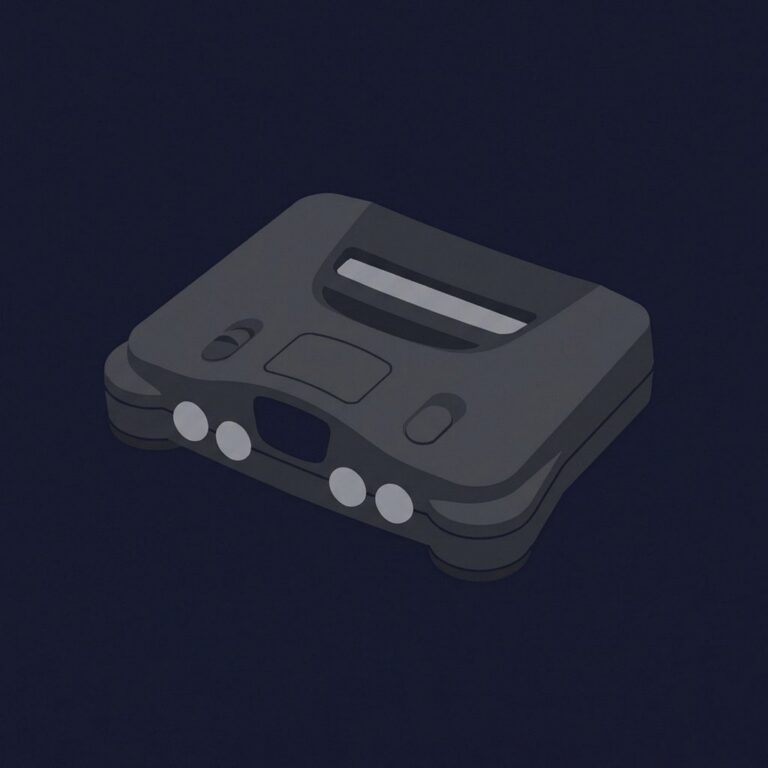
Few consoles capture the spirit of an era quite like the Nintendo 64. Launched in June 1996 in Japan and September 1996 in North America, the N64 arrived as the last major home console to use cartridges as its primary media format. It sold 32.93 million units worldwide, and while that number paled next to Sony’s PlayStation, the N64 carved out a legacy built on groundbreaking 3D gameplay, four-player local multiplayer, and some of the most beloved titles in gaming history.
History & Development
The Nintendo 64 began life as Project Reality, a collaboration between Nintendo and Silicon Graphics, Inc. (SGI) announced in 1993. SGI had made its name building high-end graphics workstations for Hollywood studios, and the partnership promised to bring that visual horsepower into living rooms at a consumer price point. The project went through several name changes — first “Ultra 64,” then finally “Nintendo 64” — before its release.
Nintendo made a decision that would define the console’s entire trajectory: sticking with cartridges instead of adopting the CD-ROM format that Sony and Sega had embraced. The reasoning was sound on paper. Cartridges offered near-instant load times, greater durability (particularly important for younger players), and built-in copy protection. But the trade-offs were severe. ROM cartridges cost significantly more to manufacture than CDs, which drove up retail game prices. Storage capacity topped out at 64 MB compared to a CD’s 650 MB, limiting developers’ ability to include full-motion video, extensive voice acting, and large soundtracks.
This cartridge commitment drove away major third-party publishers. Square, which had been a Nintendo loyalist through the NES and SNES eras, famously moved Final Fantasy VII to the PlayStation. The defection sent shockwaves through the industry and signaled that Nintendo’s grip on third-party support had loosened considerably.
Despite the controversy, the N64 launched to enormous demand. The Japanese launch on June 23, 1996 moved 500,000 units in the first week. The North American launch on September 29, 1996 was equally explosive, with the console priced at $199 USD alongside the system-selling Super Mario 64.
Hardware & Technical Specifications
At the heart of the Nintendo 64 sits a 64-bit NEC VR4300 CPU running at 93.75 MHz, a custom variant of the MIPS R4300i architecture. Paired with it is the Reality Co-Processor (RCP), a custom chip clocked at 62.5 MHz that handled both graphics processing (the Reality Display Processor) and audio (the Reality Signal Processor). This unified design gave the N64 impressive polygon-pushing capabilities, rated at roughly 150,000 polygons per second.
The base system shipped with 4 MB of Rambus RDRAM, a high-bandwidth but expensive memory technology. In 1998, Nintendo released the Expansion Pak, a module that doubled the RAM to 8 MB. Certain games required it — most notably The Legend of Zelda: Majora’s Mask and Donkey Kong 64 — while others used it to enable higher resolutions or improved textures. The console supported output resolutions of 256×224, 320×240, and 640×480 (the latter primarily with the Expansion Pak).
The N64 controller was revolutionary and divisive in equal measure. Its trident-shaped design with three handles looked alien at launch, but it introduced the analog stick as a standard input for 3D gaming — a feature every major controller has included since. The center handle housed the analog stick, while the left handle offered a traditional D-pad. Nintendo also pioneered force feedback with the Rumble Pak accessory, first bundled with Star Fox 64 in 1997. The controller’s expansion port on the bottom accepted memory cards and other accessories, establishing a modular approach to controller functionality.
Audio output delivered 48 kHz 16-bit stereo — technically CD-quality sound — though cartridge storage constraints meant developers often had to compress audio heavily. Video output was limited to composite and S-Video, with no RGB output on the standard console (a modification popular among enthusiasts).
Game Library & Legacy
The Nintendo 64’s library of 387 games is small by any standard — the PlayStation had over 2,400. But what the N64 lacked in quantity, it compensated with era-defining quality. Super Mario 64 essentially wrote the rulebook for 3D platforming. The Legend of Zelda: Ocarina of Time remains one of the highest-rated games of all time. GoldenEye 007 proved that first-person shooters could work brilliantly on consoles and practically invented the console FPS multiplayer experience.
The console’s four controller ports — built into the hardware, not requiring a multitap accessory — made it the undisputed king of local multiplayer. Mario Kart 64, Super Smash Bros., Mario Party, Perfect Dark, and Diddy Kong Racing turned living rooms into competitive arenas. For many players who grew up in the late 1990s, four-player N64 sessions remain some of their strongest gaming memories.
Third-party support was the N64’s persistent weakness. Without Square, Enix, Konami’s major franchises (Metal Gear moved to PlayStation), and many of Capcom’s key titles, the console leaned heavily on Nintendo’s own output and contributions from Rare. Rare was the N64’s most prolific and celebrated third-party developer, delivering GoldenEye, Banjo-Kazooie, Banjo-Tooie, Perfect Dark, Donkey Kong 64, Diddy Kong Racing, Conker’s Bad Fur Day, and Jet Force Gemini — a run of output that remains remarkable.
The RPG genre was notably underserved. While the PlayStation became the definitive RPG platform of its generation, the N64 had only a handful of entries: Paper Mario, Ogre Battle 64, and Quest 64 among the most notable. This absence reinforced a perception of the N64 as a “kiddy” console, a stereotype competitors were happy to amplify.
Models & Variants
The Nintendo 64 launched in a standard dark gray housing, but Nintendo aggressively pursued color variants as a sales strategy — and it worked. The Funtastic series introduced six translucent colors in 1999-2000: Fire Orange, Grape Purple, Ice Blue, Jungle Green, Smoke Gray, and Watermelon Red. These vibrant, see-through shells proved popular, particularly with younger buyers and female gamers — demographics Nintendo was specifically targeting.
Special editions pushed collector appeal further. The Gold N64, released in limited quantities in various markets, remains one of the most sought-after standard variants. The Pikachu edition, featuring a blue-and-yellow sculpted console with Pikachu’s foot as the power button, came in multiple regional variations. The rarest standard production unit is the Smoke Black edition, a Japanese exclusive tied to the ill-fated 64DD disk drive peripheral.
The Nintendo 64DD deserves mention as the console’s most ambitious and least successful accessory. This magnetic disk drive connected to the expansion port on the bottom of the N64 and offered 64 MB of rewritable storage. It launched only in Japan in December 1999, supported by just 10 games, and was discontinued within a year. Today, 64DD units and their software are among the rarest Nintendo collectibles.
Collecting & Value Today
The Nintendo 64 sits in a collecting sweet spot: old enough to carry strong nostalgia, widely produced enough to be accessible, but with enough rare titles and variants to offer serious depth. A standard gray console in good condition with one controller typically sells for $60-100 USD. Funtastic color variants command premiums of $100-200+ depending on color and condition, with boxed units reaching considerably higher.
The game library is where values get interesting. Common titles like Mario Kart 64 and Super Mario 64 remain affordable at $30-50 loose. But the N64 has several legitimate heavy hitters: Conker’s Bad Fur Day regularly sells for $100+ loose, while complete-in-box copies of sought-after titles like Clay Fighter: Sculptor’s Cut (a Blockbuster exclusive with fewer than 20,000 copies produced) can reach $500+. Stunt Racer 64, Worms Armageddon, and Bomberman 64: The Second Attack round out the high-value end of the library.
For buyers entering the N64 market, controller quality is the primary concern. The original analog sticks wear down with use, becoming loose and imprecise. Replacement sticks (both OEM-style and third-party alternatives using GameCube-style mechanisms) are widely available. When purchasing used consoles, always test the analog stick tension and the Expansion Pak slot for proper contact. The cartridge slot itself is robust — the N64’s build quality is excellent overall, and hardware failures are rare compared to other consoles of the era.