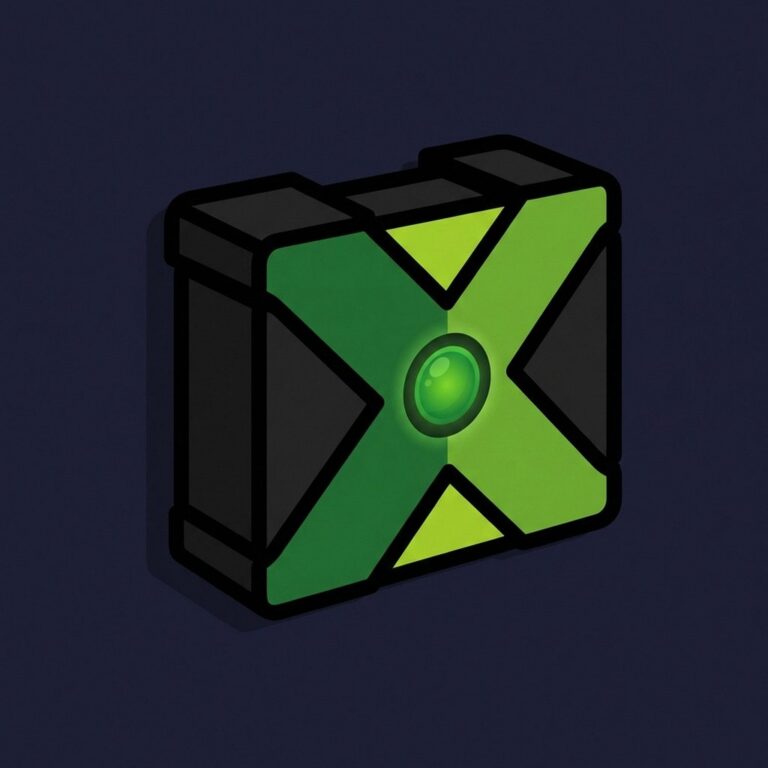
The original Microsoft Xbox was the most improbable console ever made. A software company with zero gaming hardware experience built a massive, 8.5-pound black box powered by modified PC components and launched it directly against the PlayStation 2 — the best-selling console in history. It should have been a disaster. Instead, Halo: Combat Evolved made the Xbox a legitimate platform, Xbox Live invented modern online console gaming, and Microsoft established itself as a permanent force in the industry. The Xbox sold 24 million units — a distant third behind the PS2 and GameCube — but it achieved something more important: it proved Microsoft belonged.
History & Development
The Xbox project began in 1998 when a small team within Microsoft, including Seamus Blackley (a game developer and physicist), Kevin Bachus, Ted Hase, and Otto Berkes, proposed a gaming console to compete with Sony’s upcoming PS2. The team’s pitch to Bill Gates in early 2000 was contentious — Gates was reportedly skeptical of hardware and concerned about the business model (losing money on every console sold). He eventually approved the project.
Microsoft’s approach was distinctly un-console: they used off-the-shelf PC components — an Intel Pentium III at 733 MHz, an NVIDIA custom GPU (derived from the GeForce 3), a hard drive (an industry first for consoles), and an Ethernet port (built-in, not optional). This made the Xbox easy to develop for (essentially a DirectX-based PC) but expensive to manufacture — Microsoft reportedly lost $100-125 per unit sold at launch.
The Xbox launched on November 15, 2001 at $299. Halo: Combat Evolved, developed by Bungie (which Microsoft had acquired in 2000), was the launch title. It was — and remains — one of the most important console launches in history. Halo didn’t just sell Xboxes; it legitimized the entire platform.
Hardware & Technical Specifications
The Xbox was the most powerful 6th-generation console by a significant margin. The 733 MHz Pentium III outclassed the PS2’s 294 MHz Emotion Engine and GameCube’s 485 MHz Gekko. The NVIDIA NV2A GPU supported hardware transform and lighting, pixel shaders, and resolutions up to 1080i — the Xbox was the first console to support HD output as a standard feature.
64 MB of unified DDR RAM was double the PS2’s split 32+4 MB architecture. The built-in 8-10 GB hard drive was revolutionary — it eliminated memory cards entirely, allowed game data caching for faster loads, and enabled custom soundtracks (rip CDs to the drive and play your own music in games). The NVIDIA SoundStorm audio processor supported Dolby Digital 5.1 encoding in real-time and 256 simultaneous audio channels.
The controller — nicknamed “The Duke” — was enormous, designed for American hands and widely mocked in Japan. Microsoft replaced it with the smaller Controller S (originally the Japanese design), which became the standard and evolved into the template for every Xbox controller since.
Game Library & Legacy
The Xbox’s library of 968 games was built on a foundation of Western-developed titles. Halo and Halo 2 (2004) were the platform’s pillars — Halo 2 was the most-played game on Xbox Live and generated $125 million on launch day. Fable (Peter Molyneux’s ambitious RPG), Ninja Gaiden (the brutally difficult action game from Team Ninja), Star Wars: Knights of the Old Republic (BioWare’s RPG masterpiece), Forza Motorsport, and Jade Empire were standout exclusives.
Cross-platform titles consistently looked and ran best on Xbox — Half-Life 2, Doom 3, The Elder Scrolls III: Morrowind, and Splinter Cell demonstrated the hardware’s superiority. The Xbox also became the home platform for Grand Theft Auto in addition to PS2.
Xbox Live, launched in November 2002 for $49.99/year, was the Xbox’s most lasting contribution. It provided a unified online gaming service with friends lists, voice chat, matchmaking, and downloadable content — features that seem obvious now but were revolutionary in 2002. Halo 2’s Xbox Live multiplayer fundamentally changed how console gamers played together.
Collecting & Value Today
Original Xbox consoles are affordable at $40-80 USD. The biggest concern is the clock capacitor — in version 1.0-1.5 motherboards, this component leaks acid over time and can destroy the motherboard. Removing or replacing the clock capacitor is essential maintenance for any original Xbox. Most games are under $15, though Steel Battalion (with its massive dedicated controller) commands $200-500+. Stubbs the Zombie, Conker: Live & Reloaded, and Panzer Dragoon Orta are among the pricier titles at $40-80.