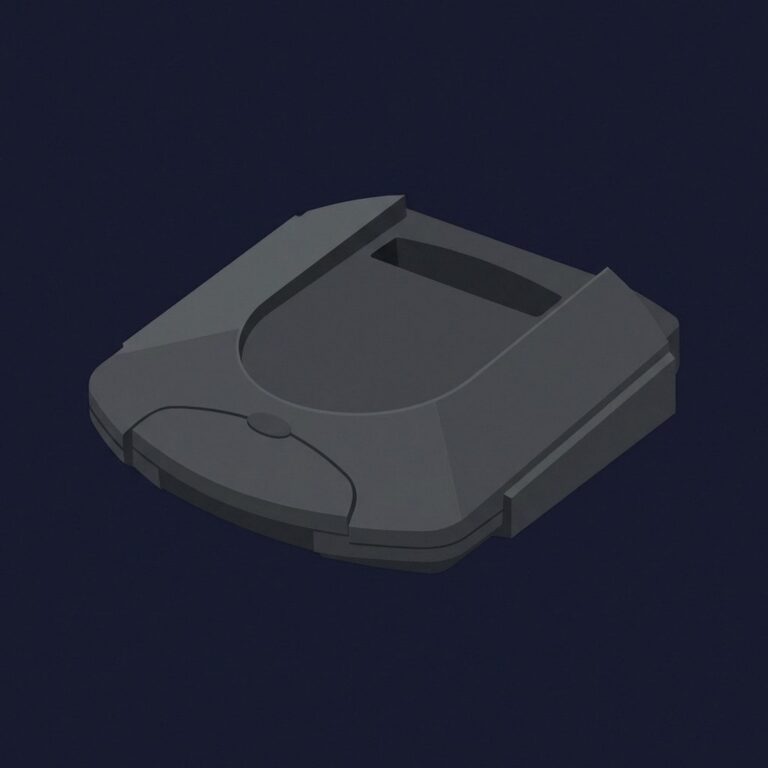
The Atari Jaguar was the last gasp of one of gaming’s founding companies. Marketed as the “first 64-bit console” — a claim that was technically creative and practically misleading — the Jaguar was Atari’s final attempt to compete in the home console market. It had a handful of genuine classics (Tempest 2000 alone justifies its existence), a controller so complex it included a telephone keypad, and a software library so thin that most of its 50 games struggled to demonstrate why anyone needed 64 bits. The Jaguar sold approximately 250,000 units and effectively ended Atari as a hardware manufacturer.
History & Development
Atari Corporation, under Jack Tramiel’s leadership, contracted two custom chip designs from Flare Technology, a British semiconductor firm. The resulting processors — Tom (handling graphics, object processing, and blitting) and Jerry (handling audio, DSP, and peripheral I/O) — each contained 64-bit data buses, which Atari used to justify the “64-bit” marketing claim. In reality, the system’s main CPU was a standard Motorola 68000 at 13.3 MHz — a 16/32-bit processor from 1979. The “64-bit” designation was hotly debated then and remains controversial among hardware enthusiasts.
The Jaguar launched on November 23, 1993 in New York and San Francisco at $249.99 — strategically priced below the 3DO ($700) and SNES ($200). National rollout followed in 1994. Atari’s marketing leaned heavily on the 64-bit claim: “Do the Math” advertisements compared the Jaguar’s supposed bit-count to the 16-bit SNES and Genesis.
The Jaguar CD add-on arrived in September 1995 for $149.95, adding CD-ROM capability. Only 13 CD games were released. The unit was plagued by reliability issues — the laser assembly was notoriously fragile. By 1996, Atari had merged with JT Storage in a reverse takeover, effectively ending the Jaguar and Atari as a console manufacturer.
Hardware & Technical Specifications
The Jaguar’s architecture was powerful but poorly balanced. Tom operated at 26.6 MHz and contained an object processor (for sprites), a GPU (a 32-bit RISC processor programmable for general tasks), and a 64-bit blitter for fast memory copies. Jerry ran at the same speed and contained a DSP (usable for both audio and general computation) and the audio DAC. The Motorola 68000 was intended as a system manager, not the primary processor — but many developers, struggling with Tom and Jerry’s custom architecture, defaulted to running game logic on the familiar 68000, leaving the custom chips underutilized.
The controller was polarizing: a standard D-pad and three action buttons (A, B, C) augmented by a 12-button numeric keypad with game-specific overlays. The keypad provided extra inputs but made the controller bulky and awkward. A 6-button “Pro Controller” was released later, replacing the keypad with three additional face buttons — universally considered superior.
Game Library & Legacy
Tempest 2000 (1994) by Jeff Minter is the Jaguar’s masterpiece — a psychedelic update of Atari’s classic vector shooter that remains one of the greatest arcade-style games ever made. It is the single best argument for owning a Jaguar. Alien vs. Predator (1994) was a strong FPS exclusive. Iron Soldier (mech combat) and Rayman (later ported everywhere) were solid titles. Doom on Jaguar was a competent port, though missing the PC version’s music.
The rest of the library was sparse and uneven. Cybermorph (the pack-in game) was mediocre. Kasumi Ninja (a Mortal Kombat clone) was embarrassing. Checkered Flag (racing) was technically poor. The Jaguar had perhaps 10-15 worthwhile games out of 50 — not enough to sustain a platform.
Collecting & Value Today
The Jaguar has a dedicated collector community. Working consoles sell for $150-250 USD. Tempest 2000 commands $60-100+. The rarest titles — Battlesphere (a late homebrew-turned-commercial release limited to ~500 copies), Air Cars, and Iron Soldier 2 (cartridge version) — reach $200-1,000+. The Jaguar CD add-on is itself rare and expensive at $200-400+, with functional units increasingly scarce due to the fragile laser assembly. The Jaguar’s active homebrew scene produces new games regularly, keeping the platform alive decades after Atari’s demise.