
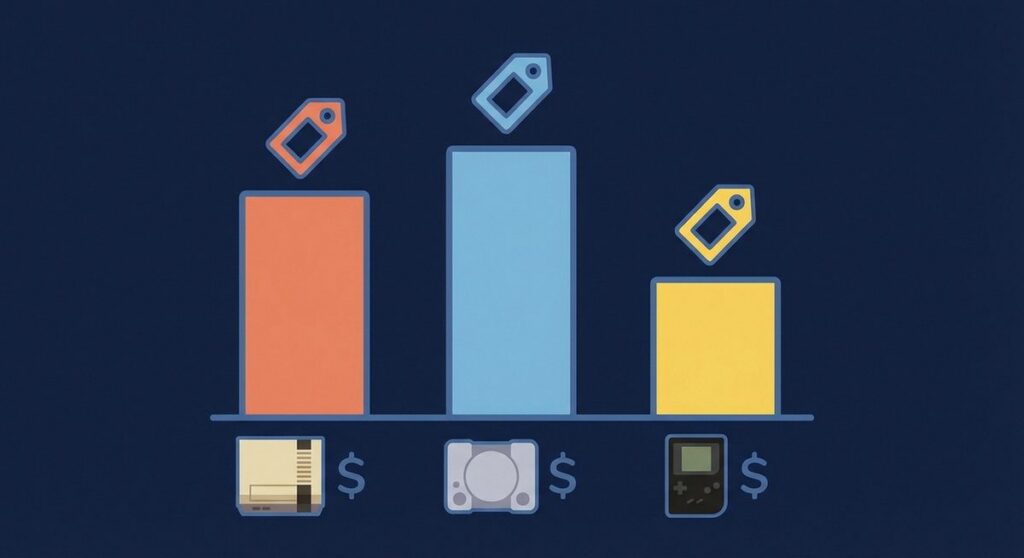
How much did your favorite console really cost? A $199 console in 1977 and a $499 console in 2020 aren’t remotely comparable without adjusting for inflation. This guide converts every major console’s launch price to 2026 US dollars, revealing which systems were genuine bargains and which asked consumers to make serious financial commitments.
The 1970s: Premium Prices for Primitive Hardware
Early consoles were expensive relative to their capabilities. Adjusted for inflation, several 1970s systems cost more than a modern PS5.
- Magnavox Odyssey (1972) — $99.99 → ~$740 in 2026
- Fairchild Channel F (1976) — $169.95 → ~$925 in 2026
- Atari 2600 (1977) — $199.99 → ~$1,020 in 2026
The Atari 2600 at over $1,000 in today’s money puts modern console pricing in perspective. Early adopters paid premium prices for technology that was revolutionary but, by any modern standard, extraordinarily limited.
The 1980s: The Market Finds Its Price
The 1980s saw launch prices begin to stabilize as manufacturers learned what consumers would pay. The video game crash of 1983 taught the industry that overpriced hardware with poor software was a recipe for disaster.
- Intellivision (1979) — $299 → ~$1,280 in 2026
- ColecoVision (1982) — $199 → ~$640 in 2026
- NES (1985) — $199 → ~$575 in 2026
- Sega Master System (1986) — $199 → ~$565 in 2026
- TurboGrafx-16 (1989) — $199.99 → ~$500 in 2026
The NES at ~$575 was a significant purchase in 1985 — roughly equivalent to a high-end gaming console bundle today. Nintendo’s genius was the pack-in game (Super Mario Bros.) and the “it’s a toy, not a computer” marketing that justified the expense to parents.
The 1990s: The Console Wars Heat Up
The 16-bit and 32/64-bit eras brought aggressive pricing as multiple manufacturers competed for market share. Some of the best value propositions in console history emerged from this competition.
- Sega Genesis (1989) — $189.99 → ~$475 in 2026
- SNES (1991) — $199 → ~$455 in 2026
- 3DO (1993) — $699 → ~$1,500 in 2026
- Atari Jaguar (1993) — $249.99 → ~$535 in 2026
- Sega Saturn (1995) — $399 → ~$810 in 2026
- PlayStation (1995) — $299 → ~$610 in 2026
- Nintendo 64 (1996) — $199.99 → ~$395 in 2026
- Dreamcast (1999) — $199 → ~$370 in 2026
The 3DO at ~$1,500 was the most expensive mainstream console launch ever in inflation-adjusted terms — and its failure proved that raw hardware power couldn’t justify that price without a compelling game library. The N64 at ~$395 and Dreamcast at ~$370 were arguably the best deals of the decade.
The 2000s: Loss Leaders and Market Strategy
By the 2000s, console manufacturers had embraced the razor-and-blades model — selling hardware at or below cost and profiting from software licensing. This dramatically lowered effective launch prices.
- PlayStation 2 (2000) — $299 → ~$540 in 2026
- Xbox (2001) — $299 → ~$525 in 2026
- GameCube (2001) — $199 → ~$350 in 2026
- Xbox 360 (2005) — $299/$399 → ~$475/$635 in 2026
- PlayStation 3 (2006) — $499/$599 → ~$770/$925 in 2026
- Wii (2006) — $249 → ~$385 in 2026
The GameCube at ~$350 was the best value of the generation — Nintendo priced it aggressively to compete with the PS2’s dominant market position. The PS3 at ~$925 for the 60 GB model was the most expensive mainstream console since the 3DO, and its slow early sales reflected the price resistance.
The 2010s-2020s: Stabilization and Digital Options
Modern console pricing has settled into a predictable range, with digital-only editions offering savings.
- Wii U (2012) — $299/$349 → ~$405/$475 in 2026
- PlayStation 4 (2013) — $399 → ~$530 in 2026
- Xbox One (2013) — $499 → ~$665 in 2026
- Nintendo Switch (2017) — $299 → ~$370 in 2026
- PlayStation 5 (2020) — $499 → ~$595 in 2026
- Xbox Series X (2020) — $499 → ~$595 in 2026
- Xbox Series S (2020) — $299 → ~$355 in 2026
The Xbox One at $499 (bundled with the initially mandatory Kinect) launched $100 above the PS4 and paid dearly for it — Microsoft reversed course within a year. The Nintendo Switch at ~$370 continues Nintendo’s pattern of competitive pricing.
Key Takeaways
Consoles Have Actually Gotten Cheaper
Despite sticker shock at $499-599 price tags, modern consoles are significantly cheaper in real terms than their 1970s and 1980s predecessors. An Atari 2600 cost the equivalent of two PS5s.
The $300 Sweet Spot
The most commercially successful consoles — NES, SNES, PS1, PS2, Wii, Switch — all launched near the $200-300 nominal range. Systems that exceeded $400 at launch (3DO, Saturn, PS3, Xbox One with Kinect) consistently struggled in their early years.
Pricing Determines Winners
In nearly every generation, the most affordable console with a competitive game library won. The PS1 undercut the Saturn. The PS2 was cheaper than the Xbox. The Wii undercut both the PS3 and 360. The PS4 undercut the Xbox One. Price isn’t everything — but it’s close.