
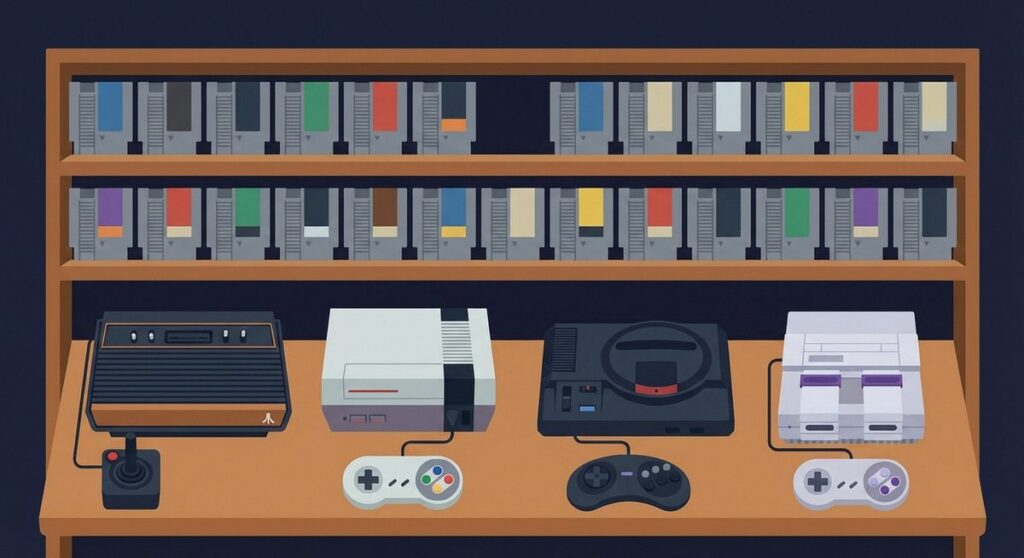
Getting into retro game collecting can be overwhelming. Dozens of platforms, thousands of games, wildly different price ranges — where do you start? This guide ranks the best consoles for new collectors based on four factors: game library quality, affordability (both console and games), hardware reliability, and pure fun factor. Whether you want to spend $50 or $500, there’s a perfect entry point for you.
Best Overall: Super Nintendo (SNES)
The SNES is the gold standard for retro collecting. Its library is arguably the greatest ever assembled — Super Mario World, The Legend of Zelda: A Link to the Past, Super Metroid, Chrono Trigger, Final Fantasy VI, Donkey Kong Country, and EarthBound are just the beginning. The hardware is nearly indestructible — SNES consoles from 1991 still work perfectly today with minimal maintenance.
The catch is price. While the console itself is reasonable at $60-100, popular games have climbed significantly. EarthBound runs $200+ loose. Chrono Trigger is $150+. But common titles like Super Mario World, Donkey Kong Country, and Street Fighter II are still $15-30. Start with the affordable classics and work toward the rarities.
Best Value: PlayStation 2
If you want the most gaming for the least money, the PS2 is unbeatable. The console sells for $40-70. The library of 4,000+ games is the largest of any console. And because 155 million PS2s were sold, games are everywhere — thrift stores, garage sales, used game shops. Most titles cost $5-15. You can build a library of 50 excellent games for what 5 SNES games would cost.
The Slim model (SCPH-70000 series) is recommended — smaller, cooler-running, and less prone to the disc read errors that plagued early fat models. The PS2 also plays PS1 games, effectively doubling your library access.
Best for Beginners: Nintendo 64
The N64 is the easiest console to collect for. The console is $40-70. Cartridges are durable — no discs to scratch, no cases needed. The library is small enough (296 games in North America) that a complete collection is theoretically achievable. And the multiplayer games — GoldenEye 007, Mario Kart 64, Super Smash Bros., Mario Party — are instant fun with friends.
Most N64 games are $10-30. The expensive titles are well-known: Conker’s Bad Fur Day ($100+), Sculptors Cut ($300+), and a handful of late releases. Controllers are the weak point — the analog stick wears out with heavy use. Buy extras or look for third-party replacements with improved sticks.
Best for Japanese Gaming: Sega Saturn
The Saturn is an underappreciated gem. In North America, its library is modest and some titles are expensive. But import a Japanese Saturn and the equation changes dramatically. Japanese Saturn games are abundant and cheap — $5-20 for many titles. The system excels at 2D fighters, shoot-em-ups, and RPGs. The Saturn is region-locked, but region-free modifications or an Action Replay cartridge (which also provides RAM expansion) solve this easily.
Best for Arcade Gaming: Sega Genesis
The Genesis delivers fast, arcade-style gaming at bargain prices. Consoles are $30-60. The vast majority of its 900+ game library costs $5-15. Sonic the Hedgehog, Streets of Rage 2, Gunstar Heroes, Castlevania: Bloodlines, and Phantasy Star IV are affordable and excellent. The hardware is rock-solid. The Model 1 with a Sega CD adds another dimension to collecting if you want to expand later.
Best for Modern Retro: GameCube
The GameCube hits a sweet spot — retro enough to feel nostalgic, modern enough to still play well by today’s standards. The console is cheap at $40-70. The library includes some of Nintendo’s best work: Metroid Prime, The Wind Waker, Resident Evil 4, Super Smash Bros. Melee. However, GameCube game prices have skyrocketed in recent years — popular titles routinely exceed $50-80, and rarities like Cubivore or Gotcha Force reach $200+.
Best for Portable Collecting: Game Boy Advance
The GBA is the best entry point for handheld collecting. The GBA SP (with backlight) sells for $50-80 and plays the entire Game Boy, Game Boy Color, and GBA library — three generations on one device. GBA games are small, durable cartridges that are easy to store. Prices are reasonable for most titles, with gems like Metroid Fusion, Advance Wars, Golden Sun, and the Pokemon titles all available for $20-50.
Tips for New Collectors
Start with What You Know
Nostalgia is a powerful motivator. Collect for the console you grew up with first — you already know what games you want and what they should cost.
Buy Loose Cartridges First
Complete-in-box games cost 2-5x more than loose copies. Unless display is your priority, loose cartridges and discs are the way to build a library affordably.
Test Before You Buy
For disc-based systems, surface scratches usually don’t matter — deep scratches and disc rot do. For cartridges, dirty contacts are the most common issue and are easily cleaned with isopropyl alcohol and a cotton swab.
Avoid the Hype
Retro game prices fluctuate. A YouTube video or social media trend can spike a game’s price overnight. Be patient — prices often come back down. Set a budget, stick to it, and enjoy the hunt.