The Nintendo Switch has one of the largest game libraries of any console — roughly 13,600+ released games as of 2026 and still growing, with over 1.5 billion total game copies shipped. The all-time best-selling Switch game is Mario Kart 8 Deluxe, at over 71 million copies.
The Nintendo Switch is the most successful product Nintendo has ever made. A hybrid console that plays on the TV at home and in your hands on the go, the Switch solved a problem Nintendo had been circling for decades: how to unify their home console and handheld businesses into a single platform. With over 143 million units sold, a game library exceeding 5,000 titles, and individual games selling 40-60 million copies each, the Switch didn’t just succeed — it vindicated Nintendo’s entire philosophy of innovation over specification.
History & Development
The Switch was born from the Wii U’s ashes. By 2014, it was clear the Wii U had failed, and Nintendo began developing its successor under the codename “NX.” The key insight was that Nintendo’s handheld business (3DS) had remained strong even as their home console struggled. What if they could combine both into one device?
Nintendo partnered with NVIDIA, choosing the Tegra X1 mobile processor — a departure from the IBM/AMD partnerships that had powered Nintendo consoles since the GameCube. The Tegra X1 was a proven mobile chip, efficient enough for portable use while powerful enough (especially with custom optimizations) for respectable TV gaming at 1080p.
The Switch was revealed via a three-minute trailer on October 20, 2016 — one of the most effective console reveals in history. The concept was instantly understandable: click the Joy-Cons off the tablet, put it in the dock for TV play, take it on the go. No confusion, no explanation needed. The contrast with the Wii U’s muddled messaging was total.
The Switch launched worldwide on March 3, 2017 at $299 alongside The Legend of Zelda: Breath of the Wild — a game immediately hailed as a masterpiece. Demand exceeded supply for months. Within its first year, the Switch had sold 14.86 million units, surpassing the Wii U’s entire lifetime sales.
Hardware & Technical Specifications
The Switch’s NVIDIA Tegra X1 contains a quad-core ARM Cortex-A57 CPU at 1.02 GHz and a Maxwell-based GPU with 256 CUDA cores. Performance scales between modes: docked, the GPU runs at 768 MHz (393 GFLOPS) outputting up to 1080p; in handheld mode, it drops to 307 MHz targeting the built-in 720p display. This dynamic scaling was elegant — games automatically adjusted resolution and performance based on play mode.
The 4 GB LPDDR4 RAM and mobile-class storage (32 GB internal, expandable via microSD) were modest specifications even by 2017 standards. The Switch was dramatically less powerful than the PS4, let alone the PS4 Pro or Xbox One X. But Nintendo understood — correctly — that the hybrid concept’s convenience would outweigh raw graphical inferiority for most consumers.
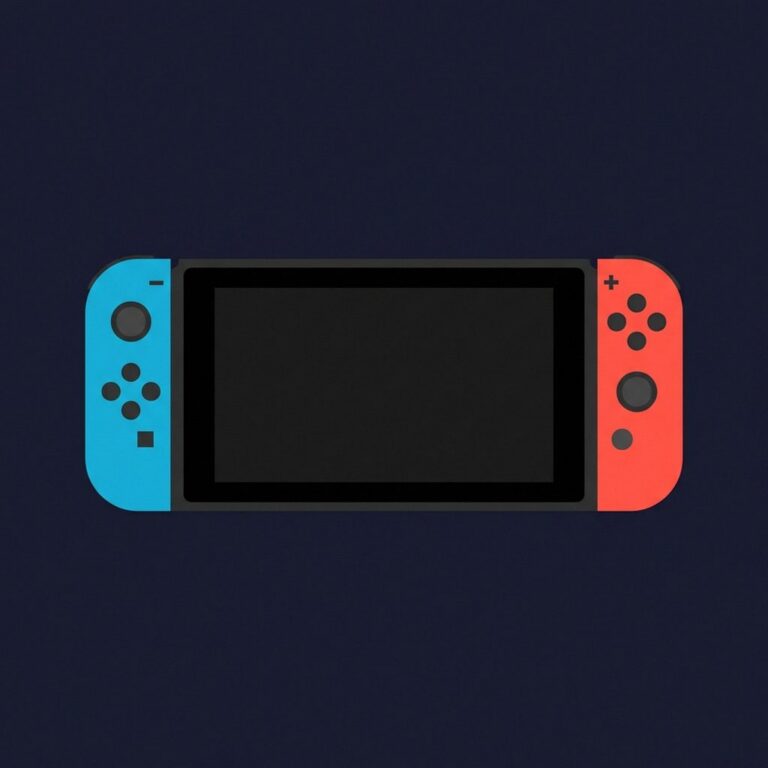
The Joy-Con controllers were the Switch’s most distinctive hardware feature. Each Joy-Con functioned independently as a miniature controller (with an analog stick, four buttons, shoulder buttons, and motion controls), could attach to the tablet for handheld play, or slot into the Joy-Con Grip for a traditional controller experience. This versatility enabled instant local multiplayer anywhere — hand someone a Joy-Con and play Mario Kart on a plane.
Joy-Con “drift” — analog sticks registering phantom input due to mechanical wear — became a widespread and persistent issue, leading to class-action lawsuits and a free repair program from Nintendo. Despite this, the Joy-Con concept itself was widely praised.
The Switch OLED Model (October 2021) upgraded the display to a 7-inch OLED panel with deeper blacks and more vibrant colors, added a wider adjustable kickstand, doubled the internal storage to 64 GB, and included an Ethernet port on the dock. The Switch Lite (September 2019) was a handheld-only variant at $199 with no detachable Joy-Cons and no TV output.
Game Library & Legacy
The Switch’s library earned a perfect 10. Nintendo’s first-party output was relentless:
The Legend of Zelda: Breath of the Wild (2017) redefined open-world gaming with its physics-based exploration and emergent gameplay. Its sequel, Tears of the Kingdom (2023), expanded those systems with construction mechanics and sold 20+ million copies. Super Mario Odyssey (2017) was the best 3D Mario since Galaxy. Mario Kart 8 Deluxe — a Wii U port — has sold over 62 million copies, making it one of the best-selling games of all time. Animal Crossing: New Horizons (2020) became a cultural phenomenon during COVID-19 lockdowns, selling 44+ million. Super Smash Bros. Ultimate (2018) assembled the largest crossover roster in gaming history at 89 fighters.
Third-party support was the Switch’s biggest improvement over Wii U. While the hardware couldn’t run the most demanding AAA titles natively, developers embraced the platform through optimized ports (The Witcher 3, Doom Eternal, Skyrim), cloud versions, and original titles. The indie scene thrived on Switch — games like Hollow Knight, Celeste, Stardew Valley, and Hades found enormous audiences who valued portable play.
Models & Variants
Three main Switch models exist: the original Switch (HAC-001, later revised to HAC-001(-01) with improved battery life), the Switch Lite (HDH-001, handheld-only), and the Switch OLED (HEG-001). Numerous limited editions were produced — Animal Crossing (pastel blue/green), Splatoon 3 (gradient purple), Zelda: Tears of the Kingdom (gold/green), and Pokémon variants are among the most sought-after.
Collecting & Value Today
The Switch remains a current platform (with a successor expected), so collecting is premature. Standard consoles sell for $200-250 USD new, with used units at $150-200. Limited edition consoles command modest premiums. Game prices are notoriously stable — Nintendo first-party titles rarely drop below $40 even years after release, a phenomenon known as the “Nintendo tax.” This price stability may benefit long-term collectors, as Nintendo games tend to appreciate rather than depreciate once discontinued.
Around 13,600+ released titles — one of the largest libraries of any console — with over 1.5 billion game copies shipped. Mario Kart 8 Deluxe, with over 71 million copies sold as of March 2026. The Legend of Zelda: Breath of the Wild and Tears of the Kingdom, Super Mario Odyssey, Animal Crossing: New Horizons, Super Smash Bros. Ultimate, and Mario Kart 8 Deluxe. March 3, 2017, in a simultaneous worldwide launch (no regional split). 155.92 million as of March 31, 2026 — among the best-selling consoles of all time.
Frequently Asked Questions
How many games does the Nintendo Switch have?
What is the best-selling Nintendo Switch game?
What are the must-play Switch games?
When did the Nintendo Switch come out?
How many Switch consoles have been sold?