
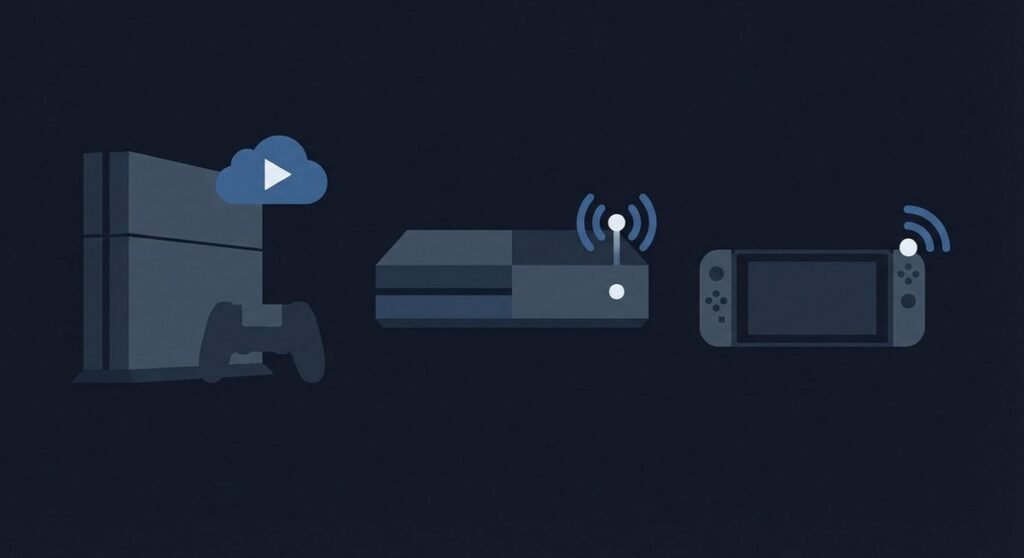
The 2010s were a decade of transformation and fragmentation in console gaming. The generation began with Nintendo’s Wii U stumbling badly, continued with Sony’s PS4 dominating while Microsoft’s Xbox One struggled to find its identity, and ended with the Nintendo Switch rewriting the rules of what a console could be. Along the way, mid-generation hardware refreshes became standard (PS4 Pro, Xbox One X), subscription services emerged as a major business model (Xbox Game Pass, PlayStation Now), and indie games rose from curiosities to system-sellers.
The 8th Generation Console War
The decade opened with the Wii U (November 2012) — Nintendo’s ambitious but poorly marketed tablet-controller console that sold just 13.56 million units. A year later, the PS4 and Xbox One launched within a week of each other in November 2013. Sony’s aggressive gamer-first messaging and $100 price advantage over the Kinect-bundled Xbox One established a lead that Microsoft never overcame. The PS4 finished the generation with 117.2 million units; the Xbox One managed roughly 51 million.
Microsoft’s recovery under Phil Spencer — who took over Xbox in March 2014 — focused on services and backward compatibility rather than matching Sony exclusive-for-exclusive. Xbox Game Pass (June 2017) offered hundreds of games for a monthly subscription fee, fundamentally challenging the $60 game purchase model. Sony responded with PlayStation Now, though it never achieved the same cultural impact.
The Nintendo Switch Revolution
The Nintendo Switch (March 2017) was the decade’s most significant hardware launch. Its hybrid design — home console and portable in one device — was immediately understood and universally appealing. Launching alongside The Legend of Zelda: Breath of the Wild, the Switch sold 14.86 million units in its first year and surpassed the Wii U’s lifetime sales within 10 months. By the end of the decade, it had sold over 70 million units and would continue to 143+ million — proving that Nintendo’s innovation-over-power philosophy, when executed clearly, could dominate any generation.
Mid-Generation Hardware Refreshes
The 2010s introduced the concept of iterative console upgrades. The PS4 Pro (November 2016) and Xbox One X (November 2017) offered significantly enhanced graphics — particularly for 4K and HDR displays — without creating separate game libraries. Every game ran on both base and enhanced models. This approach borrowed from the smartphone upgrade cycle and became standard practice heading into the 9th generation.
The Indie and Digital Revolution
Digital distribution matured dramatically. By the end of the decade, over 80% of PS4 game sales were digital. Indie games — once marginal curiosities on console platforms — became some of the decade’s most celebrated titles: Hollow Knight, Celeste, Undertale, Cuphead, Stardew Valley, Dead Cells, and Hades competed with (and often surpassed) AAA releases in critical acclaim. The Switch, with its portable play advantage, became the preferred indie platform.
Streaming and Cloud Gaming
The decade saw the first serious attempts at cloud gaming. OnLive (2010) launched its MicroConsole for game streaming but shut down in 2015. Google Stadia (November 2019) arrived with massive hype and Google’s infrastructure behind it but failed to gain traction — eventually shutting down in January 2023. Xbox Cloud Gaming (formerly xCloud) integrated into Game Pass Ultimate showed more promise by not requiring a dedicated device. The technology worked, but consumer appetite for streaming-only gaming remained limited.
The Decade’s Legacy
The 2010s established that services matter as much as hardware. Game Pass, PlayStation Plus, and the Nintendo eShop became central to each platform’s value proposition. The decade also proved that innovation trumps power — the Switch, dramatically weaker than both the PS4 and Xbox One, outsold them both. Most importantly, the 2010s saw gaming become fully mainstream entertainment, with industry revenue surpassing $150 billion annually — exceeding film and music combined.