
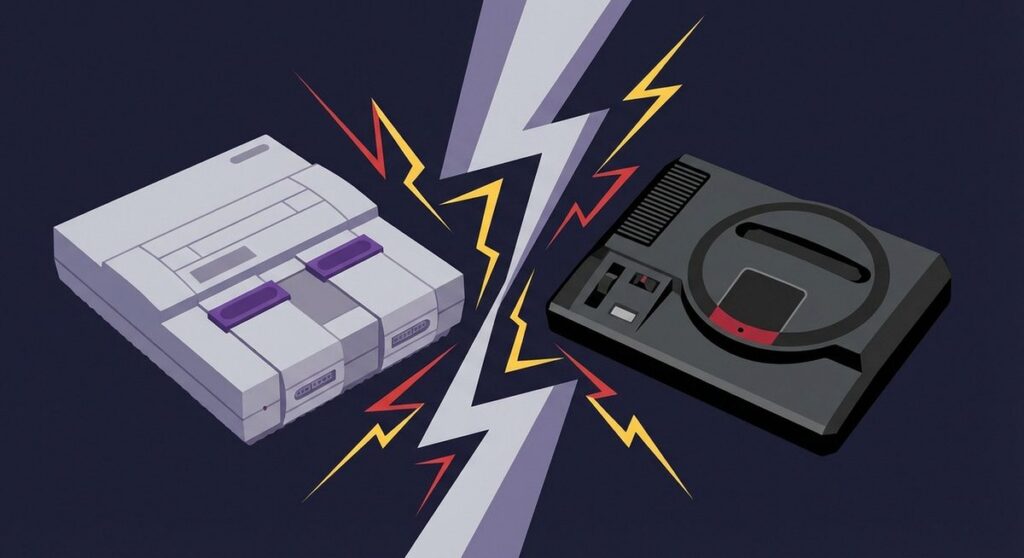
The rivalry between the Super Nintendo Entertainment System and the Sega Genesis wasn’t just a competition between two consoles — it was the defining conflict of an era. From 1989 to 1995, Nintendo and Sega waged war across living rooms, schoolyards, and magazine pages in a battle so fierce it became known simply as “the console wars.” It was personal, it was tribal, and it shaped an entire generation’s relationship with gaming.
Hardware: Mode 7 vs. Blast Processing
The Genesis arrived first, launching in North America on August 14, 1989 with a Motorola 68000 CPU at 7.67 MHz. The SNES followed on August 23, 1991 with a Ricoh 5A22 CPU at 3.58 MHz. On paper, the Genesis had a faster main processor. In practice, the comparison was far more nuanced.
The SNES compensated for its slower clock speed with a more sophisticated graphics architecture. Its dedicated PPU (Picture Processing Unit) could display 256 colors simultaneously from a palette of 32,768, compared to the Genesis’s 64 on-screen colors from 512. The SNES also featured Mode 7 — a hardware scaling and rotation capability that created pseudo-3D effects seen in games like F-Zero, Super Mario Kart, and Pilotwings. The Genesis had nothing comparable built into its base hardware.
Sega’s response was marketing genius: “Blast Processing.” The term referred to a legitimate (if obscure) DMA technique that could update the Genesis’s color palette mid-scanline, but Sega’s advertising used it as a catch-all claim that the Genesis was simply faster. It was one of the most effective marketing campaigns in gaming history — technically defensible but practically misleading. Millions of kids believed it.
Audio was another clear SNES advantage. The Sony SPC700 chip with 8 channels of 16-bit ADPCM audio and 64 KB of dedicated sound RAM produced rich, orchestral soundtracks. The Genesis used a Yamaha YM2612 FM synthesis chip with 6 channels that created a distinctive, crunchy sound — beloved by some, grating to others. Games like Streets of Rage 2 demonstrated the YM2612’s strengths, but the SNES consistently produced more conventional and polished music.
The Marketing War
Sega of America, led by CEO Tom Kalinske, launched one of the most aggressive marketing campaigns in entertainment history. “Genesis does what Nintendon’t” was confrontational, comparative advertising that directly attacked Nintendo — something virtually unheard of in the gaming industry at the time.
Sega positioned the Genesis as the cool, edgy alternative. Their mascot Sonic the Hedgehog (1991) was designed as the anti-Mario — fast, impatient, with attitude. The contrast was deliberate: Mario was safe and family-friendly; Sonic was radical and rebellious. Sega targeted older teens and young adults, while Nintendo maintained its all-ages image.
The Mortal Kombat controversy in 1993 crystallized the difference. Nintendo censored the SNES version, replacing blood with sweat and toning down fatalities. Sega released the Genesis version with a code that enabled full gore. The Genesis version outsold the SNES version three to one. Nintendo learned its lesson — the SNES version of Mortal Kombat II was uncensored.
Game Libraries: RPGs vs. Sports and Speed
The SNES library was defined by Nintendo’s first-party excellence and an extraordinary collection of Japanese RPGs. The Legend of Zelda: A Link to the Past, Super Metroid, Super Mario World, Donkey Kong Country, Chrono Trigger, Final Fantasy VI, EarthBound, Secret of Mana — the SNES arguably has the greatest RPG library of any console ever made.
The Genesis countered with arcade action and sports. Sonic the Hedgehog (1, 2, 3 & Knuckles), Streets of Rage, Gunstar Heroes, Phantasy Star IV, Shining Force II, and Castlevania: Bloodlines represented the best of the action genre. EA Sports titles — particularly Madden NFL and NHL ’94 — were Genesis exclusives early in the generation and helped Sega dominate the sports gaming market.
The Genesis also had a significant head start. By the time the SNES launched in 1991, the Genesis had a two-year library advantage in North America and had already established its user base.
Regional Differences
The console wars played out very differently across regions. In North America, the Genesis dominated from 1991 to 1993, capturing approximately 65% of the 16-bit market at its peak. The SNES gradually clawed back share and overtook the Genesis by 1994-1995 as Sega’s attention shifted to the Saturn.
In Japan, it was never close. The Super Famicom crushed the Mega Drive, outselling it by roughly 4 to 1. Nintendo’s dominance of the Japanese market and the SNES’s superior RPG library made it the default choice.
In Europe, the battle was more balanced, with the Genesis (sold as the Mega Drive) performing strongly in the UK and France. In Brazil, the Mega Drive dominated completely thanks to Tec Toy’s local manufacturing and distribution.
Who Won?
By raw numbers, the SNES won: approximately 49.1 million units sold worldwide versus the Genesis’s 30.75 million. But this misses the point. The Genesis transformed Sega from a distant also-ran into a legitimate challenger that split the market roughly in half during the generation’s peak years. Before the Genesis, Nintendo held over 90% of the North American market. After, they never held that kind of dominance again.
Legacy
The 16-bit console wars established the template for every hardware rivalry that followed — PlayStation vs. Xbox, iOS vs. Android. They taught the industry that marketing mattered as much as hardware, that exclusives drove console adoption, and that competition produced better games for everyone. The SNES and Genesis were both extraordinary consoles. The fact that they forced each other to be better is the real victory.