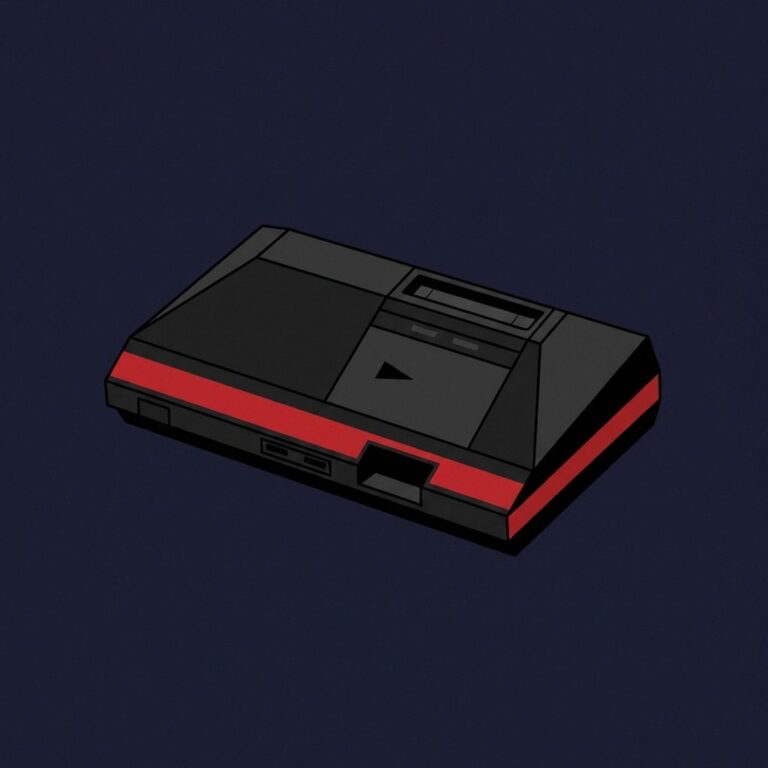
The Sega Master System is Sega’s third-generation 8-bit home console. It launched in North America in September 1986, Europe in August 1987, and Japan on October 18, 1987 — though in Japan it was a redesigned rebrand of the earlier Sega Mark III, first released there on October 20, 1985.
The Sega Master System is a console defined by geography. In Japan and North America, it was a footnote — crushed by Nintendo’s overwhelming dominance. In Brazil, it was a national institution, manufactured and sold for over two decades. In Europe, it was the console that established Sega as a legitimate competitor. The Master System sold approximately 13 million units worldwide, but that global figure masks wildly different stories depending on where you lived.
History & Development
The Master System evolved from Sega’s first home console, the SG-1000 (1983). Sega released the upgraded SG-1000 Mark II in 1984, then the significantly more powerful Mark III on October 20, 1985 in Japan. The Mark III was essentially a new console — new CPU, new graphics capabilities, new game library — but maintained backward compatibility with SG-1000 cartridges and Sega Cards.
For Western markets, the Mark III was redesigned with a sleeker case and rebranded as the Sega Master System. It launched in North America in September 1986 at $200 and in Europe in August 1987. The hardware was identical to the Mark III, with minor cosmetic and regional differences.
In Japan, the Master System faced the Famicom — and lost decisively. Nintendo’s stranglehold on third-party developers, enforced through strict exclusivity contracts, left the Master System with a thin game library compared to the Famicom’s massive catalog. Sega discontinued the Master System in Japan relatively quickly, shifting focus to the Mega Drive by 1988.
In North America, the story was similar. Nintendo’s licensing practices (which would later draw antitrust scrutiny) prevented most publishers from supporting both platforms. The NES had Mario, Zelda, Metroid, and Mega Man. The Master System had competent but less iconic alternatives. Sega sold its US distribution rights to Tonka in 1987 and took them back in 1989, but neither arrangement could crack Nintendo’s dominance.
Europe and Brazil were different. Nintendo’s distribution in these markets was weaker, handled by various regional distributors rather than a single focused entity. The Master System found eager audiences. In Brazil, Tec Toy manufactured and distributed the system, creating localized games, exclusive titles, and keeping the hardware in production into the 2000s. Brazil became the Master System’s largest market.
Mark III, Master System and What the Rename Changed
The Japanese Sega Mark III went on sale on October 20, 1985 at ¥15,000. Sega of America picked the Master System name for the export version, and the Japanese market got a console of that name only on October 18, 1987, priced at ¥16,800. That Japanese Master System carried a built-in Yamaha YM2413 FM sound chip, which had been an optional add-on for the Mark III. Western Master Systems left the chip out, so most Western versions of a game play with the plainer PSG sound.
One Console, Three Different Markets
In North America the Master System shipped at $200 in September 1986 with a light gun, two controllers and a cartridge holding Hang-On and Safari Hunt. Nintendo’s licensing terms stopped NES publishers from releasing the same games on other consoles, and Sega had only two American third-party publishers, Activision and Parker Brothers, whose agreements ended in 1989. Estimates put North American sales at 1.5 to 2 million by early 1992, when production stopped. The NES sold more than 34 million in the same market. The last licensed North American release was Sonic the Hedgehog in 1991.
Europe went the other way. Mastertronic in the UK, Master Games in France and Ariolasoft in West Germany handled the first distribution, with Virgin Mastertronic taking over in 1988. The UK launch price was £99. In 1990 Sega sold 918,000 consoles in Europe against Nintendo’s 655,000, and Virgin Mastertronic alone sold 150,000 Master Systems in the UK. Western Europe had an installed base of more than six million by 1993, and Europe kept the system in production until 1996, long after North America had stopped.
Brazil is the unusual case. Tec Toy was founded in September 1987, and it launched the Master System officially in September 1989. The company reports 8 million Master System units sold in Brazil by 2016, and it was still selling plug-and-play Master System derivatives at the end of 2015. It also localized games for Brazilian audiences: Mônica no Castelo do Dragão (1991) turned Wonder Boy in Monster Land into a game starring a character from the Turma da Mônica comics, and a Brazil-only port of Street Fighter II followed in 1997. The Master System 3 Collection (2006) packed 120 built-in games into one unit. In South Korea, Samsung sold the console as the Gam*Boy from April 1989.
Hardware & Technical Specifications
The Master System was powered by a Zilog Z80A CPU at 3.58 MHz — the same processor (at the same clock speed) used in the ColecoVision, MSX computers, and later the Game Boy. The custom Sega VDP (Video Display Processor), derived from the Texas Instruments TMS9918, could display 32 colors on screen from a palette of 64 with a resolution of 256×192 pixels. It supported 64 hardware sprites (8 per scanline), each up to 8×16 pixels.
Audio came from the SN76489 PSG — a 4-channel mono sound chip (3 square wave + 1 noise). Japanese Mark III units and some later Master Systems included an additional Yamaha YM2413 FM synthesis chip that dramatically improved audio quality. Most Western games, unfortunately, were never programmed to use the FM chip, meaning Japanese versions of the same game often sound significantly better.
The Master System accepted two media formats: standard cartridges (up to 4 Mbit / 512 KB) and smaller Sega Cards — credit-card-sized ROM media that slotted into a dedicated card port on the front of the console. Sega Cards were cheaper to produce but limited in capacity, and the format was eventually phased out.
The numbers explain the trade-off. Cartridges held up to 4 Mbit (512 KB) and Cards only 256 Kbit (32 KB). The console also had an expansion slot and two controller ports, with 8 KB of main RAM and 16 KB of video RAM. The Master System II of 1990 dropped the Card slot, the reset button, the power light and the expansion port, and most regions lost the A/V port too. The 3-D glasses need the Card slot, so they do not work on a Master System II. The Light Phaser, based on the gun from Zillion, supported 13 games and was released only in the West.
Game Library & Legacy
The Master System’s library of 318 games (across all regions) is solid if unspectacular. Sega’s own titles were the highlights: Phantasy Star (1987) — one of the first JRPGs with first-person dungeon exploration and a female protagonist — is the system’s masterpiece. Alex Kidd in Miracle World (built into many Master System units) served as Sega’s mascot game before Sonic. Wonder Boy III: The Dragon’s Trap is an excellent action-RPG that received a full HD remake in 2017.
Release timing for the best-known games shows how the console was served. Alex Kidd in Miracle World came out in Japan on November 1, 1986, in North America that December and in Europe in 1987, and Sega later built it into many consoles. Phantasy Star reached Japan on December 20, 1987 and the West in November 1988, on a 4 Mbit cartridge with a battery save; the player leads a party built around a heroine named Alis. In Brazil, the best-selling games included Alex Kidd in Miracle World, Super Futebol, California Games (sold as Jogos de Verão) and the Mônica title above. North America received just over 100 games in total and Europe more than 300.
Other notable titles include Shinobi, Golden Axe Warrior (essentially Zelda for the Master System), Sonic the Hedgehog (an impressive 8-bit adaptation), Power Strike II (a rare and excellent shoot-em-up), and R-Type. The Master System also received competent ports of popular arcade games, though the NES versions were often better-known.
Sega’s 3D Glasses accessory — using active-shutter LCD technology powered through the card slot — was a genuinely innovative peripheral that predated mainstream 3D gaming by decades. Games like Zaxxon 3-D, Missile Defense 3-D, and Space Harrier 3-D offered surprisingly effective stereoscopic 3D effects.
Models & Variants
The Master System went through several hardware revisions. The original Master System (1986) was a large, angular console with both cartridge and card slots, a reset button, and a “Rapid Fire” unit built into some models. The Master System II (1990) was a cost-reduced redesign — smaller, cheaper, but with the card slot and reset button removed. Many Master System II units came with Alex Kidd in Miracle World or later Sonic the Hedgehog built in.
Regional variants abounded. The Japanese Mark III had a different (more angular) case design. Samsung produced the Gam*Boy (later Aladdin Boy) for the South Korean market. Tec Toy in Brazil produced numerous variants over the years, including portable versions and models with built-in game collections that were sold well into the 2010s.
Collecting & Value Today
The Master System is an affordable collecting platform. Working consoles sell for $40-80 USD depending on model, region, and completeness. The system is extremely durable — with no moving parts (cartridge-based, no disc drive) and robust construction, most units still function perfectly decades later.
Game prices are generally reasonable, with most common titles in the $5-20 range. The rare exceptions are notable: Power Strike II (PAL exclusive) commands $200-400+. Phantasy Star complete in box sells for $80-150+. Brazilian Tec Toy exclusives — games like Mônica no Castelo do Dragão (a localized Wonder Boy reskin) — are increasingly collectible outside Brazil.
Region and revision decide what runs on a given unit. Sega Card games and the 3-D glasses need an original Master System with the Card slot, not a Master System II. The FM sound chip is a Japanese feature. The Light Phaser games were sold only in the West.
The Master System uses RF or composite output in most regions, with RGB output available on PAL models through the DIN connector — providing excellent image quality. The system’s simple construction makes it easy to maintain and modify. Common mods include RGB output for NTSC models, region switches for playing imports, and FM audio board additions for consoles that lack the Yamaha chip.
Frequently Asked Questions
When was the Sega Master System released?
North America September 1986, Europe August 1987, and Japan October 18, 1987 (as a rebrand of the 1985 Sega Mark III).
Is the Master System the same as the Sega Mark III?
Essentially yes — the same hardware, redesigned for Western markets. The 1987 Japanese Master System added Yamaha YM2413 FM sound and 3-D-glasses support.
How many units did the Master System sell?
About 10–13 million worldwide, plus roughly 8 million additional units sold in Brazil by Tectoy (counted separately).
What CPU does the Master System use?
An 8-bit Zilog Z80A at 3.58 MHz, with 8 KB of main RAM and 16 KB of video RAM.
What was its main competitor?
The Nintendo Entertainment System / Famicom, which dominated in Japan and North America.
What came after the Master System?
The 16-bit Sega Genesis / Mega Drive, launched in 1988.
How did the Master System do in Brazil?
Tec Toy, a Brazilian company founded in September 1987, launched the Master System officially in September 1989. It localized games such as Mônica no Castelo do Dragão (1991) and reports 8 million Master System units sold in Brazil by 2016.
Is the Master System still being made?
Production of the original console ended in Europe in 1996. In Brazil, Tec Toy was still selling plug-and-play Master System derivatives at the end of 2015.