
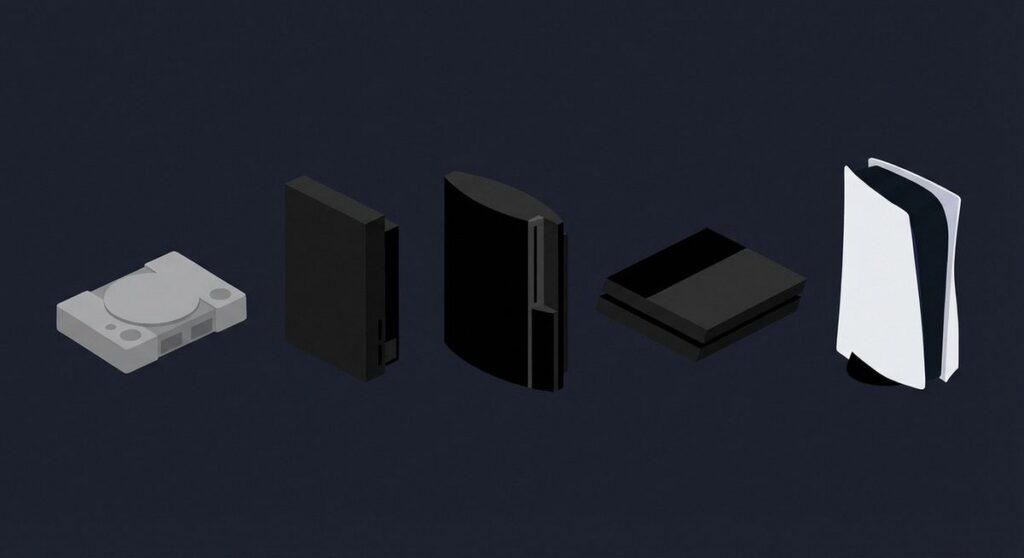
The PlayStation brand is the most commercially successful in video game history. Across five home consoles and two handhelds, Sony has sold over 500 million PlayStation systems worldwide. What makes this dominance remarkable is that it began almost by accident — born from a failed partnership with Nintendo that turned Sony from an electronics company with no gaming experience into the industry’s most powerful force.
Origins: The Nintendo Betrayal (1988-1993)
In the late 1980s, Nintendo contracted Sony to develop a CD-ROM add-on for the Super Famicom. Ken Kutaragi, a Sony engineer who had secretly helped design the SNES’s sound chip, championed the project. Sony and Nintendo agreed to create the “Play Station” — a hybrid device that could play both SNES cartridges and a new CD-ROM format.
At CES 1991, Sony announced the Play Station. The next day, Nintendo announced a competing partnership with Philips, effectively killing the Sony deal. The reasons were contractual — Nintendo realized Sony’s agreement gave them too much control over CD-based software licensing. Sony’s leadership was humiliated. Sony chairman Norio Ohga, reportedly furious at the public embarrassment, authorized Kutaragi to develop a standalone gaming console. Nintendo’s betrayal created its greatest competitor.
PlayStation (1994): The Revolution
The PlayStation launched in Japan on December 3, 1994 and in North America on September 9, 1995 at $299 — $100 less than the Sega Saturn. Powered by a MIPS R3000A CPU at 33.8 MHz with a custom GPU capable of 360,000 polygons per second, the PlayStation wasn’t the most powerful 5th-generation console on paper. But its architecture was designed for one thing: making 3D game development as easy as possible.
Sony’s strategy was revolutionary for the industry. They actively courted third-party developers with reasonable licensing fees, provided excellent development tools, and embraced the CD-ROM format’s low manufacturing costs. While Nintendo charged publishers $10-15 per cartridge and maintained strict content policies, Sony offered CD-ROMs at under $2 each with creative freedom. The result was an avalanche of third-party exclusives.
Final Fantasy VII (1997) was the tipping point. Square’s defection from Nintendo to PlayStation — driven by the N64’s cartridge limitations — brought millions of RPG fans to Sony’s platform. Combined with Metal Gear Solid, Crash Bandicoot, Resident Evil, Tomb Raider, Gran Turismo, and Tekken, the PlayStation assembled the deepest library of the generation.
The PlayStation sold 102.49 million units worldwide, making it the first console to cross the 100-million mark. The PSone redesign (2000) — a sleek, miniaturized version — extended the console’s life well into the PS2 era.
PlayStation 2 (2000): The Unbeatable
The PS2 launched on March 4, 2000 in Japan at ¥39,800 ($299 in North America). Its Emotion Engine CPU at 294.9 MHz and Graphics Synthesizer GPU were powerful, but the PS2’s true weapon was its DVD-ROM drive. In 2000, standalone DVD players cost $300-500. The PS2 was simultaneously a game console and an affordable DVD player — a value proposition that drove early sales even before the game library matured.
Full backward compatibility with the entire PS1 library meant buyers started with over 2,000 games on day one. Third-party support was overwhelming: Grand Theft Auto III, Final Fantasy X, Metal Gear Solid 2, Kingdom Hearts, God of War, Shadow of the Colossus, Guitar Hero. The PS2’s game library eventually exceeded 4,000 titles, the largest of any console.
The PS2 sold 155 million units — a record that still stands. It was manufactured until 2013, with games released until 2014, giving it one of the longest production runs in console history.
PSP (2004): The Handheld Challenger
The PlayStation Portable launched in Japan on December 12, 2004 at ¥19,800. With a stunning 4.3-inch widescreen LCD and near-PS2-level graphics powered by a custom MIPS R4000 at 333 MHz, the PSP was the first handheld to seriously challenge Nintendo’s dominance. It used proprietary UMD optical discs and also played movies and music.
The PSP sold 80 million units, a strong number by any measure — but modest compared to the Nintendo DS’s 154 million. In Japan, the PSP thrived as a platform for RPGs and Monster Hunter (which became a cultural phenomenon). In Western markets, piracy through custom firmware significantly damaged software sales.
PlayStation 3 (2006): The Costly Recovery
The PS3 launched on November 11, 2006 in Japan at the infamous price of $499/$599 (20GB/60GB models). Sony had bet heavily on the Cell Broadband Engine — a collaboration with IBM and Toshiba — and included a Blu-ray drive. The hardware was technically impressive but expensive to manufacture (estimated $800+ per unit at launch) and notoriously difficult to develop for.
The PS3’s early years were painful. The Xbox 360’s year-long head start, the Wii’s motion control phenomenon, and Sony’s own arrogance (“people will work harder to afford a PS3”) cost them dearly. Sony lost an estimated $3.3 billion on the PS3 hardware division through 2008.
But Sony recovered. Price cuts, the excellent PS3 Slim redesign (2009), and exclusive titles like Uncharted 2, The Last of Us, God of War III, and Gran Turismo 5 rebuilt the brand. The PS3 ultimately sold 87.4 million units, essentially tying the Xbox 360. And Blu-ray won the format war against HD-DVD, validating Sony’s long-term strategy.
PS Vita (2011): The Beautiful Failure
The Vita launched in Japan on December 17, 2011 with a 5-inch OLED touchscreen, dual analog sticks, and quad-core ARM Cortex-A9 processor. It was the most powerful handheld ever made, and it was a commercial disappointment. Expensive proprietary memory cards, poor first-party support, and the rise of smartphone gaming limited it to approximately 15 million units. Sony discontinued it in 2019 and has shown no interest in returning to the handheld market — until the success of the Nintendo Switch reopened the conversation.
PlayStation 4 (2013): Dominance Restored
Sony learned every lesson from the PS3. The PS4 launched on November 15, 2013 at $399 with an AMD Jaguar x86-64 CPU and Radeon GPU with 1.84 TFLOPS — a familiar PC-based architecture that developers loved. While Microsoft stumbled with the Xbox One’s confusing messaging around always-online requirements and Kinect bundling, Sony simply said: “This is a gaming console. It costs $399.”
The PS4 dominated its generation with exclusives like Bloodborne, Horizon Zero Dawn, God of War (2018), Spider-Man, and The Last of Us Part II. The PS4 Pro (2016) offered 4K capabilities for enthusiasts. Total sales reached 117.2 million units.
PlayStation 5 (2020): The Next Generation
The PS5 launched on November 12, 2020 amid the COVID-19 pandemic, priced at $499 ($399 for the Digital Edition). Its custom AMD Zen 2 CPU at 3.5 GHz and RDNA 2 GPU at 10.28 TFLOPS were significant upgrades, but the true innovation was the custom 825 GB SSD with 5.5 GB/s throughput — designed to eliminate loading screens entirely.
The DualSense controller introduced haptic feedback and adaptive triggers that provided genuinely new gameplay sensations. Exclusive titles like Demon’s Souls, Ratchet & Clank: Rift Apart, Returnal, and Final Fantasy XVI showcased the hardware’s capabilities. The PS5 has sold over 60 million units through early 2025, maintaining Sony’s position as the market leader.
The PlayStation Legacy
PlayStation’s impact extends beyond sales figures. The PS1 made gaming acceptable for adults. The PS2 made it ubiquitous. The PS3 proved Sony could recover from catastrophic mistakes. The PS4 proved they could learn from them. Across three decades, Sony has transformed from a consumer electronics company embarrassed by Nintendo into the defining brand of video game culture.