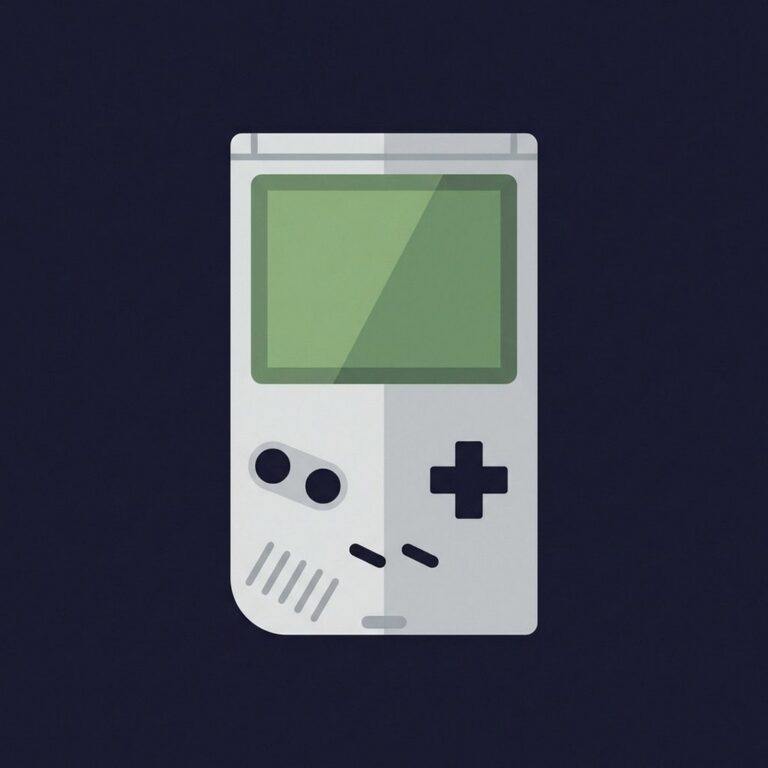
The Nintendo Game Boy is the most important handheld gaming device ever created. Launched on April 21, 1989 in Japan, it dominated portable gaming for over a decade, selling 118.69 million units (combined with the Game Boy Color) and spawning a library of over 1,000 games. Its green-tinted monochrome screen looked ancient compared to competitors like the Sega Game Gear and Atari Lynx. It didn’t matter. The Game Boy won through battery life, durability, price, and the greatest portable game library ever assembled. Its design philosophy — function over flash, gameplay over graphics — was a template Nintendo would return to again and again.
History & Development
The Game Boy was created by Gunpei Yokoi, the Nintendo engineer responsible for the Game & Watch series, the D-pad, and the NES’s R.O.B. accessory. Yokoi’s design philosophy, which he called “Lateral Thinking with Withered Technology,” meant using mature, inexpensive technology in creative ways rather than pursuing cutting-edge specs. The Game Boy was the purest expression of this idea.
Yokoi chose a monochrome reflective LCD display over a backlit color screen. The reasoning was practical: a color backlit display would have drained batteries in hours (as competitors would discover). The Game Boy’s monochrome screen ran on four AA batteries for approximately 30 hours — more than ten times the Sega Game Gear’s battery life. For a device meant to be played on car trips, in waiting rooms, and on school buses, battery endurance was paramount.
The Japanese launch on April 21, 1989 sold out instantly, with Nintendo shipping 300,000 units against far higher demand. The North American launch on July 31, 1989 at $89.95 USD — bundled with Tetris — was equally explosive. The decision to bundle Tetris instead of a Nintendo franchise title was masterstroke: Tetris appealed to everyone — children, adults, men, women — and demonstrated that the Game Boy was not just a toy for kids. Tetris went on to sell 35 million copies on the Game Boy alone, and the pairing of game and hardware became one of the most iconic bundles in gaming history.
Competitors arrived with superior technology. The Atari Lynx (1989) offered a color backlit screen, hardware scaling, and more power. The Sega Game Gear (1990) was essentially a portable Sega Master System with a color backlit display. The NEC TurboExpress (1990) could play actual TurboGrafx-16 HuCards. All three were technically superior to the Game Boy. All three lost. The Lynx, Game Gear, and TurboExpress suffered from terrible battery life (3-5 hours), higher prices, and — critically — weaker game libraries. Nintendo’s third-party licensing stranglehold ensured the best portable games appeared on Game Boy first, and often exclusively.
Hardware & Technical Specifications
The Game Boy’s Sharp LR35902 CPU was a custom hybrid incorporating elements of both the Intel 8080 and Zilog Z80 architectures, running at 4.19 MHz. It was paired with 8 KB of RAM and 8 KB of VRAM. The display was a 160×144 pixel monochrome LCD capable of showing four shades of green (technically four shades of the LCD’s native green-tinted grayscale). There was no backlight — in dim conditions, you couldn’t see the screen. This spawned a cottage industry of clip-on lights and magnifying lenses.
Sprites were limited to 8×8 or 8×16 pixels, with up to 40 sprites on screen and 10 per scanline. The hardware supported scrolling backgrounds with tile-based rendering, similar in concept to the NES but at lower resolution and without color. Programmers who understood the hardware intimately could produce surprisingly detailed visuals — later Game Boy games like Donkey Kong (1994) and Wario Land pushed the hardware further than anyone thought possible at launch.
Audio featured four channels: two pulse wave generators, one programmable wave channel, and one noise generator. Composers created memorable soundtracks within these constraints — the music from Pokémon Red/Blue, Link’s Awakening, and Mega Man on Game Boy remain iconic. A 3.5mm headphone jack was included, essential for portable use and providing stereo output.
The Link Cable was the Game Boy’s social feature: a physical cable connecting two Game Boys for multiplayer gaming and data exchange. Tetris head-to-head matches were the original killer app, but the Link Cable found its ultimate purpose with Pokémon — trading and battling creatures required connecting two Game Boys, turning the Link Cable into a social phenomenon.
Game Library & Legacy
The Game Boy’s library exceeds 1,046 games and contains some of the most influential titles in gaming history.
Tetris (1989) needs no introduction — it’s one of the most important games ever made and its Game Boy version is the definitive portable implementation. Super Mario Land (1989) was the launch Mario title, and its sequel Super Mario Land 2: 6 Golden Coins (1992) introduced Wario as a character. The Legend of Zelda: Link’s Awakening (1993) proved that a full Zelda adventure could work on portable hardware — and many consider it the finest Zelda of its era.
Pokémon Red and Blue (1996 in Japan, 1998 in NA) changed everything. Designed by Satoshi Tajiri and developed by Game Freak, Pokémon arrived late in the Game Boy’s life and single-handedly revived the platform’s commercial fortunes. It sold over 31 million copies worldwide, spawned a global media franchise worth billions, and proved that the Game Boy still had mass-market appeal nearly a decade after launch. Pokémon’s Link Cable trading and battling gave every Game Boy owner a reason to connect with other players, creating a social gaming phenomenon years before online gaming went mainstream.
Kirby’s Dream Land (1992) introduced Kirby. Metroid II: Return of Samus (1991) continued the franchise on portable. Donkey Kong (1994) was a stealth masterpiece — marketed as a port of the arcade game, it actually contained 97 original levels after the initial four arcade stages. Final Fantasy Adventure (1991) launched the Mana series. Mega Man on Game Boy produced five unique titles. Wario Land: Super Mario Land 3 (1994) gave Wario his own franchise.
Models & Variants
The original Game Boy (DMG-001, where DMG stood for “Dot Matrix Game”) was a gray brick — chunky, heavy, and virtually indestructible. The design was deliberately robust: Nintendo wanted a device that could survive being dropped by children. Stories abound of Game Boys surviving falls from balconies, being run over by cars, and — most famously — a unit that survived a Gulf War bombing in 1991 and continued to function (it’s displayed at the Nintendo Store in New York).
The Game Boy Pocket (1996) was the first major redesign: 30% smaller and significantly lighter, with a sharper screen (still monochrome but with better contrast and no green tint). It ran on two AAA batteries instead of four AAs.
The Game Boy Light (1998, Japan only) was a Game Boy Pocket with an electroluminescent backlight — finally, you could play in the dark. Its Japan-exclusive status makes it a sought-after collector’s item.
The Game Boy Color (1998) was the first major hardware upgrade, adding a color display (56 colors on screen from a palette of 32,768) while maintaining backward compatibility with the entire Game Boy library. Running on the same CPU architecture at a doubled clock speed (8.38 MHz), it was an evolution rather than a revolution. The Game Boy Color sold 49.02 million units (counted within the 118.69 million total) and its library included Pokémon Gold/Silver, Dragon Quest Monsters, and the color-exclusive The Legend of Zelda: Oracle of Ages/Seasons.
What Is a Game Boy Worth Today?
As of mid-2026, an original Game Boy (DMG-01) in working condition is worth about $40–70, with boxed examples reaching $150–250 and sealed units far beyond that. Later models differ: see the ranges below for Pocket, Color and the Japan-only Light.
The Game Boy is one of retro gaming’s most popular collecting platforms. Original DMG-001 units sell for $40-70 USD in working condition. Game Boy Pockets run $40-60. The Game Boy Color commands $50-80. The Japan-only Game Boy Light is the most expensive standard model at $100-200+. Special edition variants (Pokémon-themed, transparent, and limited-run colors) command premiums across all models.
Common games are dirt cheap: Tetris, Super Mario Land, and most sports titles sell for $3-10. Mid-tier classics like Link’s Awakening, Pokémon Red/Blue, and Kirby’s Dream Land run $15-30. The expensive end includes Shantae (Game Boy Color, $200+ loose), Trip World ($150+), and Amazing Tater ($100+). Complete-in-box pricing is significantly higher, as Game Boy game boxes were small cardboard sleeves that were frequently discarded.
The Game Boy modding community is one of the most active in retro gaming. Popular modifications include IPS/backlit screen replacements (transforming the display quality dramatically), rechargeable battery mods, custom shells, and audio amplifiers. A modded Game Boy with a modern IPS screen and clean audio is, in many enthusiasts’ opinions, the definitive way to experience the library today.