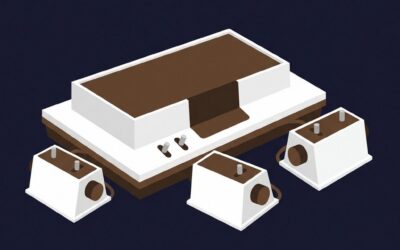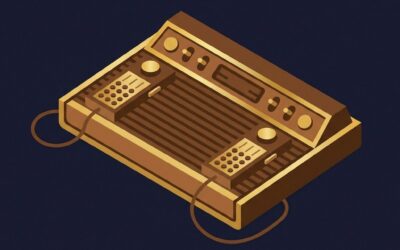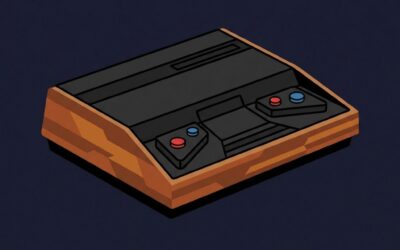
The Atari 2600 is where the video game industry truly began. Not the first console — the Magnavox Odyssey holds that distinction — but the first to prove that a cartridge-based home gaming platform could become a mass-market phenomenon. Originally launched as the Atari Video Computer System (VCS) in September 1977 at $199 USD, the 2600 sold over 30 million units across a 15-year production run that stretched from the Carter administration to the Clinton era. It made gaming a household activity, spawned the first third-party developers, and — when the market collapsed around it — nearly destroyed the industry it created.
History & Development
Atari, founded by Nolan Bushnell and Ted Dabney in 1972, had already transformed entertainment with Pong. But Pong consoles were dedicated devices — one machine, one game. The vision for the VCS was fundamentally different: a single affordable console that could play an unlimited variety of games via interchangeable cartridges. The concept wasn’t entirely new (the Fairchild Channel F beat the VCS to market by a year), but Atari had the brand recognition, the arcade catalog, and the engineering talent to make it work at scale.
The console was designed by Jay Miner (who would later create the Amiga) and Joe Decuir, using the MOS Technology 6507 CPU — a cost-reduced version of the 6502 that powered early Apple computers. The system had just 128 bytes of RAM (not kilobytes — bytes). The custom Television Interface Adaptor (TIA) chip handled both video and audio, generating graphics line-by-line in sync with the television’s electron beam. This meant programmers had to “race the beam,” writing code that could calculate and draw each scanline in real-time. It was brutally constrained and demanded extraordinary programming ingenuity.
The VCS launched in September 1977 with nine launch titles, including Combat (bundled with the console), Air-Sea Battle, and Street Racer. Initial sales were modest. Atari was spending heavily on development and marketing, and the company nearly went under before Warner Communications acquired it for $28 million in 1976 — money that funded the VCS launch.
The turning point came in 1980 with the home port of Space Invaders — the first licensed arcade-to-console conversion. It was a system seller of unprecedented power: 2600 sales quadrupled that year. Suddenly, every major arcade hit needed a home version, and the 2600 was the only platform that mattered. By 1982, Atari’s revenue reached $2 billion, and the VCS/2600 was the best-selling Christmas gift in America.
Hardware & Technical Specifications
The Atari 2600’s specifications are almost comically limited by modern standards, which makes the quality of its best software all the more impressive.
The MOS 6507 CPU at 1.19 MHz was a 6502 variant with a reduced address bus (13-bit vs. 16-bit), limiting addressable memory to 8 KB without bank switching. The 128 bytes of RAM had to store everything: game state, player positions, scores, timing variables. Programmers treated every byte as precious.
The TIA graphics chip was the system’s defining component. It could display: one background playfield (a 40-pixel-wide pattern that could be mirrored or copied), two player sprites (8 pixels wide), two missiles (1 pixel each), and one ball (1-8 pixels). That’s it. Every visual in every 2600 game — from Pac-Man’s maze to Pitfall Harry’s jungle — was constructed from these five objects. The TIA drew the screen one scanline at a time, with the programmer responsible for updating the display registers during each horizontal blanking interval. This technique, called “racing the beam,” made 2600 programming a unique discipline that combined software engineering with real-time hardware manipulation.
Colors were relatively generous: 128 colors in NTSC mode, though only 4 colors per scanline could be displayed simultaneously (background, playfield, and two sprite colors). Clever programmers changed colors between scanlines to create more colorful displays — a technique visible in games like Solaris and Pitfall II.
Audio was handled by the same TIA chip, with two channels of square wave, noise, and other synthesized waveforms. The sound was crude but recognizable — the 2600’s audio has a distinctive buzzy, electronic character that is instantly identifiable to anyone who grew up with it.
Cartridges initially held 2 KB or 4 KB of ROM. As games became more complex, bank-switching techniques allowed cartridges to contain 8 KB, 16 KB, and eventually 32 KB of ROM by swapping accessible memory banks. Later games like Pitfall II included additional hardware on the cartridge board (the DPC chip) to add capabilities the base console didn’t have.
Game Library & Legacy
The Atari 2600’s library is vast — over 565 officially released titles in North America, with hundreds more released by third parties, hobbyist developers, and across international markets. Quality varies wildly, from genre-defining classics to shovelware that helped cause the 1983 crash.
Space Invaders (1980) was the console’s breakthrough hit and the first licensed arcade port. Asteroids, Missile Command, and Centipede brought more arcade classics home. Adventure (1979) was a landmark: it created the action-adventure genre, featured the first known Easter egg in a video game (programmer Warren Robinett’s hidden credit), and proved that narrative-driven games were possible on primitive hardware.
Pitfall! (1982) by Activision was the console’s best-selling third-party game at 4 million copies, establishing the side-scrolling platformer years before Super Mario Bros. River Raid (1982), also by Activision, pioneered the vertically scrolling shoot-em-up. Yars’ Revenge (1982) was Atari’s best-selling original title. Kaboom!, Keystone Kapers, H.E.R.O., and Demon Attack showcased what skilled developers could extract from the hardware.
The 2600 also spawned the first independent game developers. Activision, founded in 1979 by four disgruntled Atari programmers (David Crane, Larry Kaplan, Alan Miller, Bob Whitehead) who were denied credit and royalties for their work, became the first third-party game publisher. Activision’s success inspired dozens of imitators — not all of them competent — contributing to the software flood that helped trigger the 1983 crash.
On the negative side, E.T. the Extra-Terrestrial (1982) — developed by Howard Scott Warshaw in just five weeks to meet a Christmas deadline — became the symbol of the industry’s excesses. Millions of unsold copies were reportedly buried in a New Mexico landfill (confirmed by a 2014 excavation). Pac-Man (1982), while commercially successful at 7 million copies, was widely criticized as a poor approximation of the arcade original, damaging consumer trust.
Models & Variants
The Atari 2600 went through multiple hardware revisions across its long life:
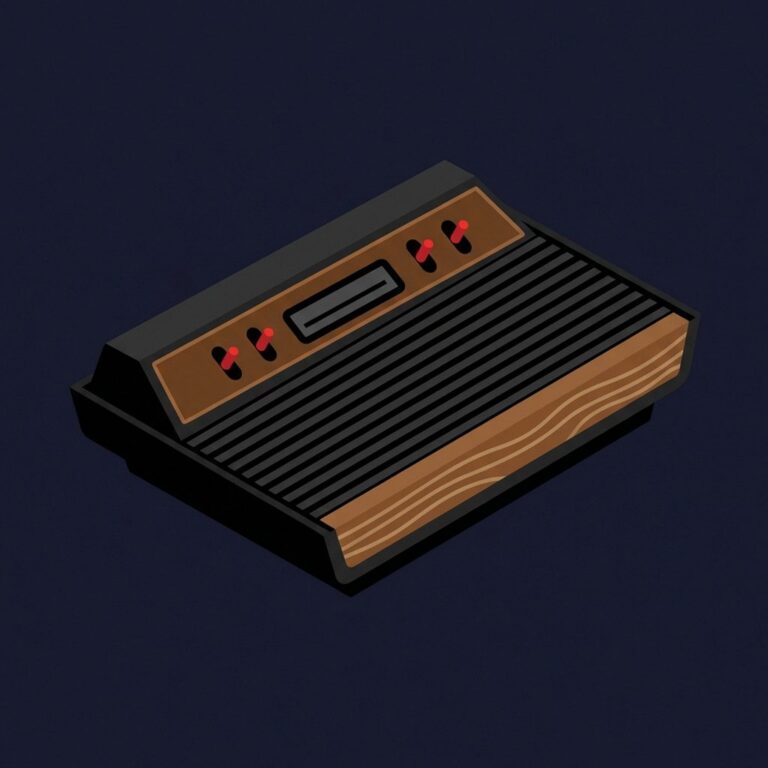
The original “heavy sixer” (1977) — named by collectors for its six internal RF shielding sections and hefty weight — featured a thick plastic shell with wood-grain veneer on the front panel and six chrome switches. It’s the most distinctive and collectible variant.
The “light sixer” (1978-1980) used the same external design but with reduced internal shielding, making it noticeably lighter. The “four-switch” model (1980-1982) simplified the front panel by removing two switches (difficulty switches moved to the back), with variations in both wood-grain (“woody”) and all-black (“Darth Vader”) designs.
The Atari 2600 Jr. (1986), designed by Barney Huang, was a dramatic cost-reduced redesign: smaller, lighter, with a sleek silver-and-black housing that looked more modern than the original. It retailed for as little as $50 and was sold alongside the Atari 7800 as a budget gaming option.
International variants include the Sears Tele-Games branded version (sold through Sears under license), the Atari 2800 (the Japanese variant with a different controller design), and Polyvox and Dactar clones produced in Brazil where the 2600 remained popular well into the 1990s.
What Is an Atari 2600 Worth Today?
As of mid-2026, a working Atari 2600 is worth about $40–90 depending on revision: heavy sixers command the most, four-switch woodgrain models sit mid-range, and the all-black 2600 Jr. is the entry point. Boxed examples and rare cartridge bundles push well past those figures.
The Atari 2600 is one of the most accessible retro collecting platforms, with hardware and common games available at low prices. Working consoles sell for $30-60 USD depending on model (heavy sixers command $80-150+). The standard CX40 joystick is plentiful at $5-15.
Common games — Combat, Pac-Man, Space Invaders, Asteroids — sell for $1-5 loose. The 2600 is likely the cheapest platform to casually collect for. Mid-tier titles like Pitfall!, River Raid, and Demon Attack run $5-15. The high end, however, can be extreme: Air Raid (one of the rarest 2600 games with a distinctive blue T-handle cartridge) has sold for over $10,000. Red Sea Crossing, Gamma Attack, and Birthday Mania are among the rarest commercially produced cartridges in gaming history.
Box and manual condition matters significantly — most 2600 games originally came in cardboard boxes that were routinely discarded. Complete-in-box copies of even common games command 5-20x the loose cartridge price. Sealed 2600 games are increasingly rare and can reach hundreds or thousands of dollars depending on the title.
Hardware-wise, the 2600 is extremely durable. The solid-state cartridge design and simple electronics mean most units still function decades later. The most common issue is corroded cartridge contacts (cleanable with isopropyl alcohol) and worn controller switches. RF output can be connected to modern TVs with a simple adapter, though dedicated retro gaming displays or upscalers produce significantly better results.