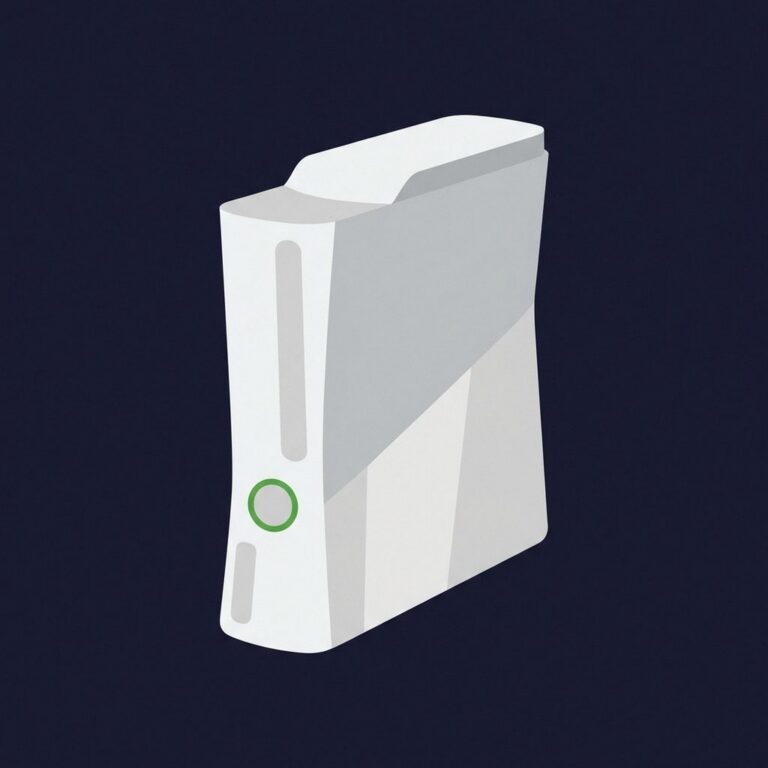
The Xbox 360 launched in North America on November 22, 2005, in Europe on December 2, 2005, and in Japan on December 10, 2005. It was Microsoft’s seventh-generation console and the successor to the original Xbox.
The Xbox 360 was Microsoft’s masterstroke — the console that transformed the company from a gaming newcomer into a legitimate platform holder. Launched on November 22, 2005, a full year before the PS3 and Wii, the 360 sold 84 million units and became the definitive online gaming platform of its generation. It also nearly self-destructed thanks to the worst hardware failure rate in console history. The Xbox 360’s story is one of brilliant strategy, catastrophic engineering, and a recovery that cost Microsoft over $1 billion but saved the brand.
History & Development
Microsoft learned harsh lessons from the original Xbox. Despite strong hardware and games, the first Xbox was sold at a loss that never recovered — Microsoft reportedly lost $4 billion on the venture. The successor, led by Xbox exec J Allard and corporate VP Peter Moore, had clear mandates: launch first, build the online ecosystem, and don’t cede the living room to Sony.
The decision to launch a year ahead of the competition was aggressive and calculated. Microsoft wanted to establish an installed base and game library before the PS3 arrived, preventing a repeat of the PS2’s dominant early-mover advantage. The strategy worked commercially but came at a devastating cost: rushing the hardware to market contributed to the Red Ring of Death (RROD) crisis.
The Xbox 360 launched at $299 (Core) and $399 (Premium) in North America. The two-SKU strategy was new for consoles and controversial — the Core unit shipped without a hard drive, which would cause compatibility issues with certain games. Supply constraints plagued the launch, with Microsoft shipping only 326,000 units for the entire North American launch window, far below demand.
The RROD crisis dominated the Xbox 360’s early years. A design flaw in the GPU’s connection to the motherboard — exacerbated by inadequate thermal management — caused a failure rate estimated between 23% and 54% depending on the source. Consoles would display three flashing red lights on the power ring, indicating a general hardware failure. Microsoft initially handled warranty claims normally, but as the scale of the problem became apparent, Peter Moore made a defining decision in July 2007: Microsoft extended the warranty to three years for RROD-specific failures and took a $1.15 billion charge against earnings. The move was financially painful but preserved consumer trust. Subsequent hardware revisions (Falcon, Jasper chipsets) progressively reduced failure rates.
Hardware & Technical Specifications
The Xbox 360’s IBM Xenon CPU featured three symmetrical PowerPC cores running at 3.2 GHz each, with each core capable of handling two hardware threads — six threads total. This was genuinely powerful hardware for 2005, though the in-order execution design meant performance was heavily dependent on developer optimization.
The ATI Xenos GPU, based on a custom R500 architecture, was the first console GPU to support unified shader architecture — a design that would later become standard in PC graphics cards. It used 48 unified shader pipelines that could flexibly handle both vertex and pixel processing, a significant advantage over the PS3’s more rigid RSX GPU in certain rendering scenarios. The GPU also introduced 10 MB of embedded DRAM (eDRAM) dedicated to frame buffer operations, enabling “free” 4x anti-aliasing on many games at no performance cost.
Memory was 512 MB of GDDR3 RAM in a unified architecture — shared between CPU and GPU. This was double the PS3’s available general-purpose memory (the PS3 split its 512 MB into 256 MB system RAM and 256 MB video RAM). The unified approach gave developers more flexibility in allocating resources, and many multi-platform developers found the 360 easier to optimize for.
The Xbox 360 controller is widely regarded as one of the best ever made. Its ergonomic design, asymmetric analog stick layout, responsive triggers, and comfortable weight set the standard that influenced the Xbox One and Series controllers. The wireless version used proprietary 2.4 GHz RF (not Bluetooth), offering reliable connectivity with minimal latency.
Xbox Live was the 360’s defining feature. Building on the original Xbox’s online foundation, the 360 version introduced the Gamerscore and Achievement system — a meta-game layer that tracked accomplishments across all titles and gave every game a standardized set of 1,000 points (200 for Xbox Live Arcade titles). Achievements fundamentally changed how people played games, adding replay incentive and bragging rights. The Xbox Live Arcade storefront also pioneered mainstream digital distribution for indie and smaller games, launching titles like Geometry Wars, Braid, Castle Crashers, and Limbo.
Game Library & Legacy
The Xbox 360’s library of 2,154 games was anchored by blockbuster exclusives and an enormous multi-platform catalog.
Halo 3 (2007) was the console’s flagship, generating $300 million in first-week sales — at the time the biggest entertainment launch in history. Gears of War (2006) defined the cover-based third-person shooter and became a system-seller. Forza Motorsport grew into a franchise rivaling Gran Turismo. Mass Effect (initially exclusive before later PS3 ports) offered RPG storytelling depth that influenced a generation of games. Left 4 Dead perfected cooperative multiplayer. Fable II delivered an accessible action RPG with moral choices.
The 360 became the default multi-platform console of its generation. Games like Call of Duty, Assassin’s Creed, FIFA, Madden, and Battlefield were typically developed with the 360 as lead platform, with PS3 versions ported afterward. This meant multi-platform titles often ran better on the 360 — higher frame rates, fewer bugs, earlier DLC — which reinforced its position among core gamers, particularly in North America and the UK.
Xbox Live Arcade deserves recognition for legitimizing digital indie distribution on consoles. Braid (2008) proved that a small team could create a culturally significant game and sell it directly to console players. Castle Crashers, Shadow Complex, Limbo, and ‘Splosion Man became hits. This infrastructure laid the groundwork for the indie game explosion that would define the following generation.
Kinect, released in November 2010 at $149, was Microsoft’s answer to the Wii’s motion control success. The camera-based peripheral offered controller-free gaming using depth sensing and skeletal tracking. It sold 35 million units and held a Guinness record as the fastest-selling consumer electronics device, though its game library was widely considered shallow. Kinect’s legacy proved more impactful outside gaming — its depth sensor technology was adopted by artists, researchers, and developers for applications Microsoft never intended.
Models & Variants
The Xbox 360 went through three major hardware generations, each addressing the reliability and feature gaps of its predecessor.
The original “fat” Xbox 360 (2005-2010) came in Core (no HDD), Premium (20 GB), and Elite (120 GB, black) configurations. Early units used the Xenon motherboard, the most RROD-prone revision. Subsequent internal revisions — Zephyr (added HDMI), Falcon (65nm CPU, reduced heat), and Jasper (65nm GPU, most reliable fat model) — progressively improved reliability. For collectors, Jasper units (identifiable by power supply amperage: 12.1A) are the only original 360s worth buying.
The Xbox 360 S (“slim,” 2010) was a complete redesign with a smaller, quieter chassis, integrated Wi-Fi, the new 45nm “Valhalla” chipset that virtually eliminated RROD, and a proprietary port for Kinect. It launched in 250 GB and later 4 GB configurations, in glossy black (and later matte black).
The Xbox 360 E (2013) was the final revision, featuring a design inspired by the Xbox One with a smaller form factor. It removed the dedicated Kinect port (requiring a USB adapter) and the S/PDIF optical audio output. Limited edition variants throughout the console’s life included Halo, Gears of War, Star Wars (an R2-D2-themed unit with custom sounds), and Call of Duty branded units.
What Is an Xbox 360 Worth Today?
As of mid-2026, a used Xbox 360 is worth about $30–70 depending on model: early Xenon units sit at the bottom of the range, while the reliable Xbox 360 S and E models and large-storage bundles reach the top. Special editions and boxed consoles go higher.
The Xbox 360 is affordable to collect for, with some important caveats around hardware reliability. Working Slim or E models sell for $40-80 USD with controller and cables. Original “fat” models are cheaper ($20-50) but carry RROD risk unless confirmed as Jasper revision. Special edition consoles command modest premiums — the Halo: Reach and Star Wars R2-D2 editions are the most collectible at $100-200+.
Game prices are generally low. The vast majority of the library falls in the $3-15 range, making it one of the cheapest platforms to build a collection for. Notable exceptions include Onechanbara: Bikini Samurai Squad, Dead or Alive Xtreme 2, and certain region-exclusive JRPGs like Culdcept Saga and Spectral Force 3 that can reach $40-80+. The Xbox Live Arcade catalog presents a preservation challenge — many digital-only titles are no longer available for purchase, and the marketplace’s uncertain long-term future makes physical games the safer collecting bet.
When buying an Xbox 360, model selection matters more than with any other console. Avoid original Xenon and Zephyr motherboard units entirely. Falcon and Jasper fat models are acceptable. Slim (S) models are the safest choice, combining reliability with full feature sets. Always test disc reading (some drives develop noise or reading issues), verify that the disc tray opens and closes smoothly on fat models (a common failure point), and check that the controller syncs wirelessly without issues.
Frequently Asked Questions
What is an Xbox 360 worth today?
As of mid-2026, a used Xbox 360 sells for about $30-70. Early Xenon-era consoles sit at the bottom of the range because of their failure history, while the later Xbox 360 S and E models and high-storage bundles reach the top. Boxed and special-edition consoles go higher.
How much did the Xbox 360 cost at launch?
$299 for the Core and $399 for the Premium 20 GB in the US; €299/€399 in Europe; £209.99/£279.99 in the UK.
How many Xbox 360 units were sold?
Microsoft's last official figure was about 84 million (June 2014). Production continued to April 2016, so roughly 85.8 million is commonly cited as the estimated lifetime total, though never officially confirmed.
When was the Xbox 360 discontinued?
Microsoft ended production on April 20, 2016, after about ten years on the market.
What was the successor to the Xbox 360?
The Xbox One, released in November 2013.
Is the Xbox 360 backward compatible?
Partially — it plays a curated list of original Xbox games through emulation, not the entire library.
What were the Xbox 360 hardware revisions?
The original 'fat' model, the slimmer Xbox 360 S (2010), and the Xbox 360 E (2013).