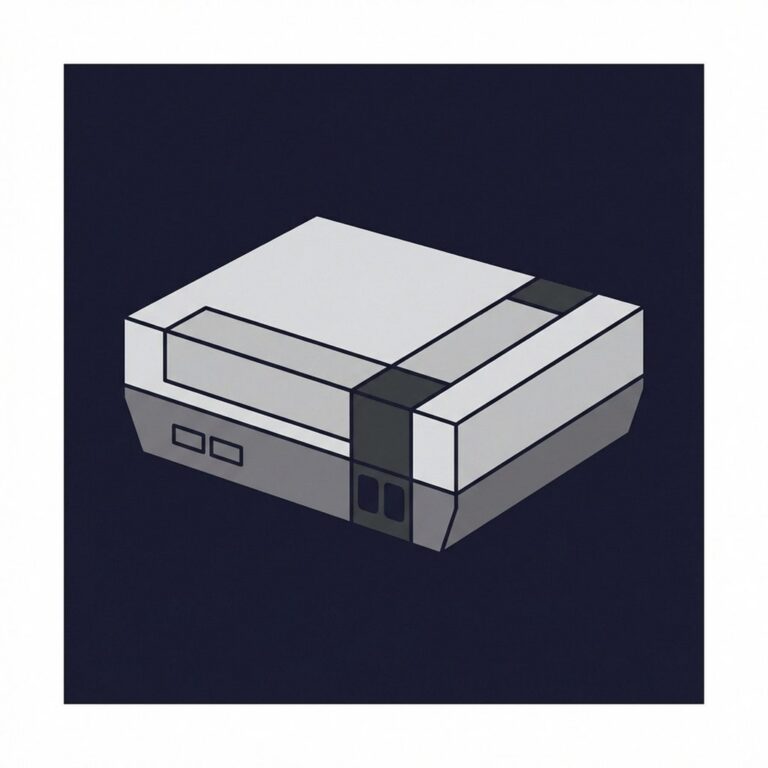
The Nintendo Entertainment System didn’t just launch a console generation — it resurrected an entire industry. When the NES arrived in North American test markets in October 1985, the video game business was considered dead. The crash of 1983 had cratered the market from $3.2 billion to $100 million. Retailers refused to stock game consoles. Atari was a punchline. Into this wasteland walked Nintendo with a gray box, a toy robot named R.O.B., and the most important game ever made: Super Mario Bros. The NES went on to sell 61.91 million units worldwide and establish Nintendo as the dominant force in gaming for decades.
History & Development
The NES began as the Family Computer (Famicom), designed by Nintendo engineer Masayuki Uemura and released in Japan on July 15, 1983 at ¥14,800 (roughly $100 USD). Its distinctive red-and-white housing and hardwired controllers were designed to be affordable and appealing to families. After a rocky start — early units had a defective chip that caused crashes, leading to a recall — the Famicom exploded in popularity, selling 2.5 million units in its first year in Japan, driven by arcade ports like Donkey Kong and original titles like Super Mario Bros.
Bringing the Famicom to North America required a fundamentally different strategy. American retailers, burned by the Atari-led crash, wanted nothing to do with “video game consoles.” Nintendo’s solution was brilliant rebranding. The console became the Nintendo Entertainment System — a deliberately vague name that avoided the toxic “video game” label. The hardware was redesigned with a VCR-style front-loading cartridge mechanism to look like consumer electronics, not a toy. Nintendo even developed R.O.B. (Robotic Operating Buddy), an accessory that made the system look more like an interactive robot than a game console, giving retailers a reason to stock it in the toy aisle.
The North American launch strategy was methodical. Nintendo tested the market in New York City during the 1985 holiday season, placing units in select stores and offering full buy-back guarantees to nervous retailers. The test succeeded, and the NES rolled out nationally in February 1986. By the end of 1986, Nintendo had sold 1.1 million units in North America. By 1988, one in three American households had an NES.
Nintendo’s third-party licensing system was revolutionary and controversial. Publishers who wanted to make NES games signed strict agreements: exclusivity windows, limited annual releases (originally five games per year), and mandatory use of Nintendo’s proprietary 10NES lockout chip, which prevented unauthorized cartridges from running. Nintendo also manufactured all cartridges, controlling supply. These restrictions ensured quality control — no repeat of the flood of terrible Atari 2600 games that contributed to the 1983 crash — but also gave Nintendo enormous power over the industry.
Hardware & Technical Specifications
The NES was powered by the Ricoh 2A03 CPU, a custom chip based on the MOS Technology 6502 core running at 1.79 MHz. It was modest hardware even by 1983 standards, but Nintendo’s engineers optimized every cycle. The CPU included a built-in audio processing unit with five sound channels: two pulse wave generators, one triangle wave, one noise generator, and one delta pulse-code modulation (DPCM) channel for low-quality samples. Despite these limitations, composers like Koji Kondo (Super Mario Bros., Zelda) and Hip Tanaka (Metroid, Kid Icarus) created iconic soundtracks that remain instantly recognizable decades later.
Graphics were handled by the Ricoh 2C02 Picture Processing Unit, which output a resolution of 256×240 pixels from a palette of 54 colors (with 25 colors displayable simultaneously). Sprites were limited to 8×8 or 8×16 pixels, with a maximum of 64 sprites on screen and only 8 per scanline — hence the characteristic flickering when too many objects appeared in a horizontal row. Developers worked around these constraints with creative tricks: sprite multiplexing, careful level design, and the use of mapper chips in cartridges to expand capabilities.
System memory was remarkably spare: 2 KB of RAM and 2 KB of VRAM. Cartridge mappers became increasingly sophisticated over the console’s life, adding bank-switching capability that allowed games to access far more ROM data than the base hardware could address directly. The most advanced NES games used mappers like the MMC5 to achieve visual effects (extra background layers, expanded VRAM) that went well beyond the original hardware specifications.
The NES controller established the template for modern gamepads: a D-pad (an invention Nintendo patented based on the Game & Watch design), two action buttons (A and B), and Start and Select. Its rectangular shape was functional rather than ergonomic, but the layout’s simplicity and the D-pad’s precision made it effective. The NES Zapper light gun, used with Duck Hunt, was the most successful light gun peripheral until the Wii era.
Game Library & Legacy
The NES library spans 716 licensed North American releases (with additional unlicensed and Famicom-exclusive titles pushing the global total much higher). Its significance lies not just in individual games but in the franchises and genres it birthed.
Super Mario Bros. (1985) defined the side-scrolling platformer and became the best-selling game of its era at 40.24 million copies (bundled with the console). Its sequels — particularly Super Mario Bros. 3, with its world map, suits, and unprecedented scope — are considered among the greatest games ever made. The Legend of Zelda (1986) pioneered non-linear exploration, battery-backed save files, and the action-adventure genre. Metroid (1986) combined exploration with atmosphere and one of gaming’s first major plot twists.
Third-party contributions were equally foundational. Konami delivered Castlevania, Contra, and Metal Gear. Capcom produced six Mega Man games and the original Ghosts ‘n Goblins. Square launched Final Fantasy. Enix brought Dragon Quest (Dragon Warrior in the West). Tecmo created Ninja Gaiden, which pioneered cinematic cutscenes in action games. Rare impressed with technically ambitious titles like Battletoads and R.C. Pro-Am.
The NES also established gaming’s commercial infrastructure. Nintendo Power magazine became the first major dedicated gaming publication. The Nintendo Seal of Quality became a consumer trust signal. Nintendo’s aggressive marketing and retail relationships created the modern model of console launches, exclusive titles, and platform loyalty that persists today.
Models & Variants
The Japanese Famicom (HVC-001) featured a compact red-and-white design with hardwired controllers (the second controller included a built-in microphone used by a few games). Its top-loading cartridge slot accepted 60-pin cartridges. The Famicom received a disc-based peripheral, the Famicom Disk System (1986), which offered rewritable storage and was home to the original releases of Zelda, Metroid, and Castlevania in Japan.
The North American NES (NES-001) used a distinctive front-loading “toaster” design with 72-pin cartridge connectors. This design, while sleek, was the source of the console’s most common hardware issue: the 72-pin connector weakened over time and with use, leading to the infamous “blinking red light” problem where the console failed to read cartridges. Every NES owner developed their own ritual of blowing into cartridges (which did nothing useful and could actually cause corrosion) and adjusting cart positioning to get games to load.
In 1993, Nintendo released the NES-101 “top-loader”, a compact redesign that eliminated the front-loading mechanism in favor of a top-loading slot similar to the Famicom. This revision fixed the connector reliability issue entirely but made a puzzling choice: it output RF video only (no composite), resulting in a softer image. Despite this, the NES-101 is popular among collectors for its reliability and clean “dogbone” controller design.
Nintendo also released the AV Famicom (HVC-101) in Japan in 1993, which added composite AV output to a top-loading Famicom design. This is widely considered the best stock NES/Famicom hardware for picture quality.
How Much Is a NES Worth Today?
As of mid-2026, a working NES-001 front-loader with controller and cables is worth about $60–100, the top-loading NES-101 $120–200, and boxed consoles $200–400+. A refurbished 72-pin connector is the detail that separates a good buy from a frustrating one.
The NES is one of the most popular retro collecting platforms, with a mature market and well-established pricing. A working front-loader console with controllers and cables typically sells for $60-100 USD. Top-loader NES-101 units command a premium at $100-180 due to their reliability. The 72-pin connector in front-loaders can be replaced for a few dollars, making non-functional units viable restoration projects.
Game pricing spans an enormous range. Common titles like Super Mario Bros./Duck Hunt, Tetris, and Excitebike sell for $5-10. Mid-tier classics like Mega Man 2, Castlevania III, and Contra run $20-50. The high end is where NES collecting gets serious: Little Samson sells for $800+ loose. Panic Restaurant, The Flintstones: Surprise at Dinosaur Peak, and Stadium Events (with a sealed copy famously selling for over $40,000) represent the ceiling. Licensed late-release titles and uncommon Sunsoft/Taito games continue to climb as the pool of available copies shrinks.
Condition matters more for NES games than most platforms. Cartridge labels are prone to wear, and the cardboard boxes (Nintendo didn’t switch to plastic cases until the Game Boy era) were frequently discarded. Complete-in-box NES games — with box, manual, styrofoam insert, and any inserts — command enormous premiums over loose cartridges, often 3-10x the loose price. For hardware, always test the 72-pin connector, check for corrosion on the cartridge pins, and verify that both controller ports function properly.