
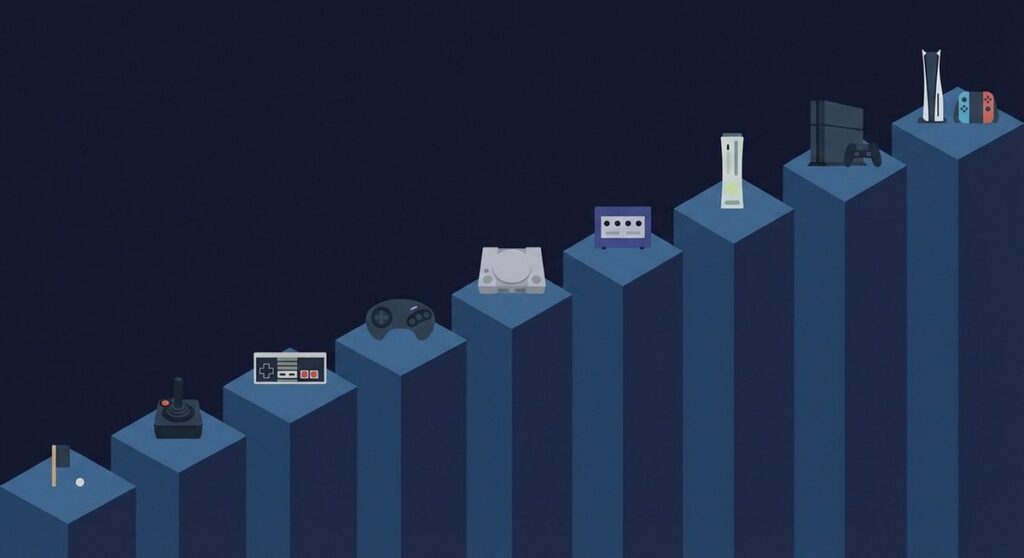
Video game console generations are the framework we use to organize over fifty years of gaming hardware into coherent eras. Each generation is defined by a cluster of competing consoles released within a similar timeframe, sharing roughly comparable technology levels and competing for the same market. Understanding these generations provides context for how the industry evolved — why certain consoles succeeded, why others failed, and how each era’s innovations built upon the last.
What Are Console Generations?
A console generation is not an official designation — no governing body declares when one generation ends and another begins. Instead, generations are determined by industry consensus based on several factors: release timing (consoles launching within a few years of each other), technological capability (similar hardware power levels), and market competition (directly competing for the same consumers). Generations typically overlap by several years, as older consoles remain in production while newer ones launch. The boundaries are fuzziest at the edges — the Dreamcast launched in 1998 but is considered 6th generation alongside consoles released in 2001.
The “bit” designation (8-bit, 16-bit, 32-bit, 64-bit) was once used as shorthand for generations but became meaningless after the 5th generation, as processor architecture diversified beyond simple bus-width comparisons.
First Generation (1972-1980)
Key systems: Magnavox Odyssey (1972), Pong consoles (1975-1977)
The first generation consisted of dedicated hardware — consoles that played only the games built into them, with no interchangeable software. The Magnavox Odyssey, designed by Ralph Baer, was the pioneer, offering simple dot-and-line games with plastic screen overlays. Following the arcade success of Pong, dozens of manufacturers released home Pong clones and variations. These consoles were essentially single-purpose electronics, closer to electronic toys than what we’d recognize as gaming platforms today.
Notable entries include the Coleco Telstar series (14 different models), the APF TV Fun, and various Pong-clone machines from companies ranging from Sears to Radio Shack. General Instrument’s AY-3-8500 chip, which contained the logic for several Pong-style games on a single integrated circuit, enabled the flood of affordable clones that defined this era.
Second Generation (1976-1992)
Key systems: Fairchild Channel F (1976), Atari 2600 (1977), Mattel Intellivision (1979), ColecoVision (1982)
The second generation introduced the defining innovation of console gaming: interchangeable ROM cartridges. The Fairchild Channel F was first, but the Atari 2600 dominated, selling over 30 million units and building a library of hundreds of games. The 2600’s success proved that the platform model — selling hardware at or near cost, profiting from software — could work at scale.
The Mattel Intellivision offered superior graphics and the first voice synthesis module. The ColecoVision delivered near-arcade-quality ports. Atari’s 5200 (1982) was the company’s premium follow-up but suffered from a notoriously unreliable controller design. This generation ended abruptly with the North American video game crash of 1983, which nearly destroyed the home console industry in the West. The crash was caused by market oversaturation, a flood of poor-quality software, and growing competition from home computers.
Third Generation (1983-2003)
Key systems: Nintendo Famicom/NES (1983/1985), Sega Master System (1986), Atari 7800 (1986)
The 8-bit era was defined almost entirely by one company: Nintendo. The Famicom/NES resurrected the console industry after the crash, establishing quality control standards (the Nintendo Seal of Quality), a licensing model for third-party developers, and franchise properties — Mario, Zelda, Metroid — that remain cornerstones of gaming. The NES sold 61.91 million units globally.
The Sega Master System was technically superior to the NES but couldn’t break Nintendo’s third-party stranglehold in North America and Japan. It found success in Europe and Brazil, where it remained popular well into the 1990s. The Atari 7800 (1986) offered backward compatibility with the 2600 library but arrived too late with too little third-party support to challenge Nintendo.
Fourth Generation (1987-2004)
Key systems: Sega Genesis/Mega Drive (1988), Super Nintendo/Super Famicom (1990), NEC TurboGrafx-16 (1989), SNK Neo Geo AES (1990)
The 16-bit era produced gaming’s most famous rivalry. The Sega Genesis launched first and captured significant market share through aggressive marketing, arcade ports, and Sonic the Hedgehog. The SNES countered with superior graphics capabilities (Mode 7, larger color palette), the era’s best RPG library, and Nintendo’s franchise muscle. Their competition — the “console wars” — became a cultural phenomenon that expanded the gaming audience dramatically.
The NEC TurboGrafx-16 was technically impressive and found a dedicated following in Japan (as the PC Engine), but failed to gain mainstream traction in North America. The Neo Geo AES offered true arcade-quality gaming at a premium price ($649), remaining a niche luxury product. This generation also saw the first major use of CD-ROM add-ons (TurboGrafx-CD, Sega CD), pointing toward the optical media future.
Fifth Generation (1993-2006)
Key systems: 3DO (1993), Atari Jaguar (1993), Sega Saturn (1994), Sony PlayStation (1994), Nintendo 64 (1996)
The 32/64-bit era brought the 3D revolution and the most significant power shift in console history. Sony, a newcomer to gaming, launched the PlayStation and leveraged CD-ROM storage, developer-friendly hardware, and aggressive third-party courtship to sell 102 million units — becoming the new market leader virtually overnight.
The Sega Saturn was powerful but complex, and Sega’s strategic missteps (surprise launch, high price, poor marketing) doomed it outside Japan. The Nintendo 64 (1996) produced era-defining games (Super Mario 64, Ocarina of Time, GoldenEye) but its cartridge format drove away third parties. The 3DO and Atari Jaguar both launched early with ambitious hardware but insufficient software, and both exited the market within a few years. This generation marked the end of Atari as a console manufacturer.
Sixth Generation (1998-2013)
Key systems: Sega Dreamcast (1998), Sony PlayStation 2 (2000), Nintendo GameCube (2001), Microsoft Xbox (2001)
The sixth generation brought the industry’s biggest-ever console (PS2), its most lamented departure (Dreamcast), and its most significant new entrant (Xbox).
The Sega Dreamcast launched with innovative features — online play, visual memory units, a passionate game library — but couldn’t overcome Sony’s momentum. Sega discontinued the Dreamcast in 2001 and exited hardware permanently. The PlayStation 2 became the best-selling console ever at 155 million units, driven by DVD playback, backward compatibility, and a staggering library of 4,489 games.
The Nintendo GameCube (2001) delivered excellent first-party software but finished third. Microsoft’s Xbox (2001) entered the market with PC-derived hardware, a built-in hard drive, and Xbox Live — the first successful console online service — establishing Microsoft as a permanent third player in the console market.
Seventh Generation (2005-2017)
Key systems: Microsoft Xbox 360 (2005), Sony PlayStation 3 (2006), Nintendo Wii (2006)
The seventh generation split the market three ways, with each console pursuing a different strategy. The Xbox 360 launched first and became the multiplatform standard, with Xbox Live Achievements and Arcade transforming online gaming. The PlayStation 3 launched at an unprecedented $499/$599 (partially justified by its Blu-ray drive) and struggled early before recovering through strong exclusives (Uncharted, The Last of Us, God of War III).
The Nintendo Wii disrupted everything. Its motion controls, accessible design, and $249 price point attracted tens of millions of non-traditional gamers, selling 101.63 million units. The Wii proved that technical power wasn’t the only path to market dominance — innovation in interface design could be equally compelling.
Eighth Generation (2012-Present)
Key systems: Nintendo Wii U (2012), Sony PlayStation 4 (2013), Microsoft Xbox One (2013), Nintendo Switch (2017)
The eighth generation was defined by Sony’s dominance, Nintendo’s recovery, and the rise of digital distribution. The Wii U (2012) failed to communicate its tablet-controller concept to consumers and sold only 13.56 million units — Nintendo’s worst home console performance. The PlayStation 4 (2013) capitalized on Microsoft’s missteps (the Xbox One’s controversial always-online plans) to sell 117 million units with a games-first strategy.
The Xbox One (2013) recovered from a poor launch through Xbox Game Pass, a subscription service offering hundreds of games for a monthly fee that reshaped industry economics. The Nintendo Switch (2017) — a hybrid home console and portable device — became a runaway hit, selling over 140 million units and demonstrating that the home/portable distinction was increasingly artificial.
Ninth Generation (2020-Present)
Key systems: Sony PlayStation 5 (2020), Microsoft Xbox Series X|S (2020)
The current generation emphasizes SSD-based storage (dramatically reducing load times), ray tracing (realistic lighting and reflections), high frame rate gaming (up to 120fps), and subscription services. The PlayStation 5 continues Sony’s exclusive-driven strategy with titles like Demon’s Souls, Ratchet & Clank: Rift Apart, and Spider-Man 2. Xbox Series X|S leans heavily on Game Pass as a value proposition, with the less powerful Series S offering a budget entry point.
This generation has seen the strongest push toward backward compatibility in console history, with both platforms playing large portions of their predecessors’ libraries. Cloud gaming (Xbox Cloud Gaming, PlayStation Now/Plus Premium) is increasingly viable but hasn’t replaced local hardware. The Nintendo Switch, while technically eighth-generation, continues to compete effectively through its unique hybrid form factor and Nintendo’s exclusive software.
Are Console Generations Still Relevant?
The concept of discrete console generations is becoming less clear-cut. Mid-generation upgrades (PS4 Pro, Xbox One X) blurred the lines within a single generation. Backward compatibility means games now span multiple generations seamlessly. Subscription services make hardware less important than ecosystem. The Nintendo Switch doesn’t fit neatly into generational categories at all — it launched four years after the PS4 but competes in its own space.
Still, generations remain useful as an organizing framework. They provide historical context, help explain market dynamics, and give collectors and enthusiasts a shared vocabulary for discussing gaming’s past. As long as hardware manufacturers continue to release new console platforms in competitive cycles, the generational model — however imperfect — will remain the standard way to map the evolution of video game hardware.