
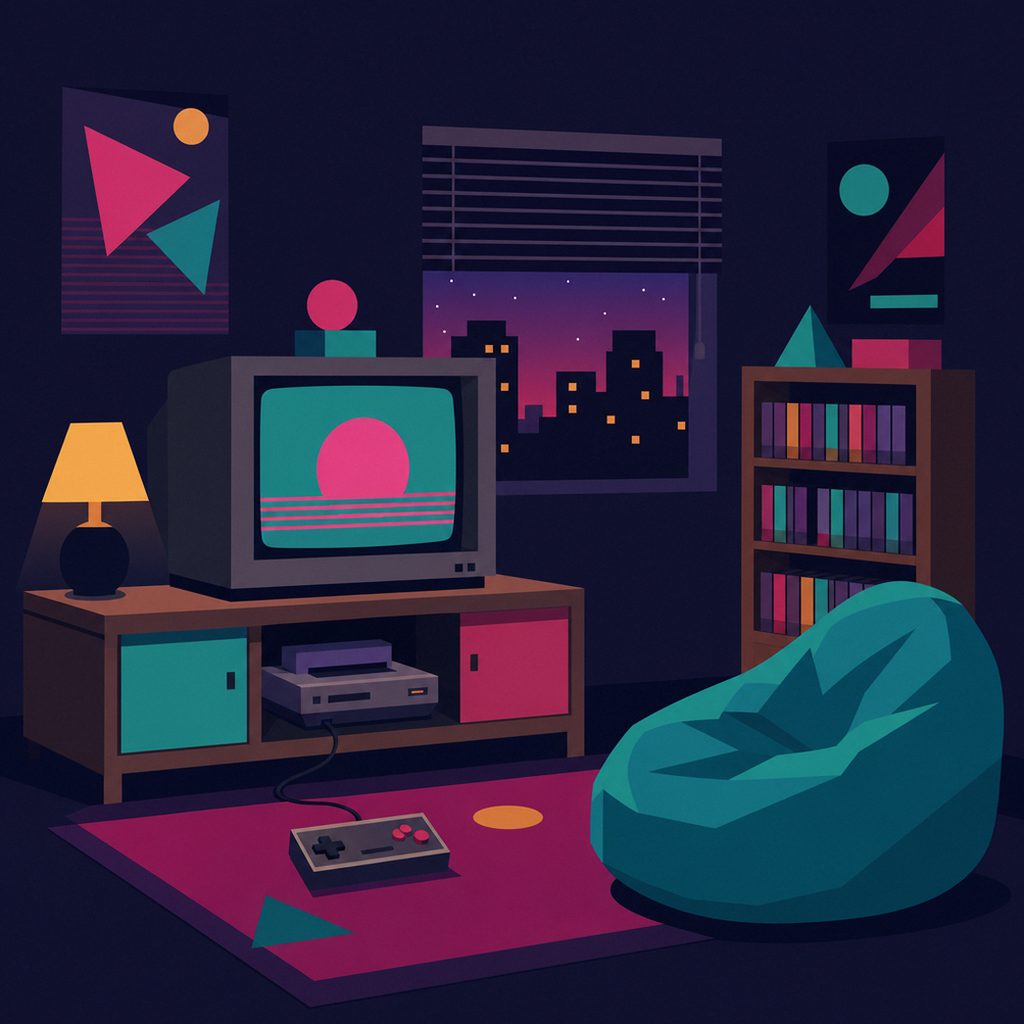
For anyone who grew up between roughly 1980 and 1999, video games were not a hobby so much as a shared language. The arcade, the home console and the school playground formed a continuous cultural space where rumours travelled faster than facts, where cheat codes were currency, and where brand loyalty to Nintendo or Sega could define a friendship. The two decades that bridged the arcade golden age and the arrival of the internet produced the habits, references and nostalgia that still shape how gaming is remembered.
Quarters and the Arcade Era
The early 1980s belonged to the arcade. Cabinets running Space Invaders (1978), Pac-Man (1980) and Donkey Kong (1981) drew teenagers into a public, competitive ritual measured in quarters and high-score initials. For many children the arcade was the first place they spent money unsupervised, and the etiquette of stacking a coin on the cabinet to claim the next game was a small social code learned by an entire generation. Pac-Man in particular escaped the arcade to become a full cultural phenomenon, complete with the hit single “Pac-Man Fever,” which reached number nine on the Billboard Hot 100 in early 1982, and a Saturday-morning cartoon that premiered the same year. The arcade was a social institution before the home console matured, and its competitive culture seeded everything that followed.
That momentum was interrupted by the video game crash of 1983, which gutted the American home market through oversaturation and a flood of low-quality cartridges. For a moment it looked as though gaming might recede into a fad. The recovery, when it came, was driven almost entirely by one company.
Nintendo Rebuilds the Living Room
Nintendo’s NES, launched in North America in 1985, rebuilt the home market from near zero. The company’s “Seal of Quality,” its strict third-party licensing model and its deliberate decision to brand the machine as an “Entertainment System” rather than a video game console all worked to restore retailer and parental confidence. The cultural effect was a near-monopoly: by the late 1980s Nintendo dominated American gaming, and “Nintendo” was for many households a generic word for video games. The console hardware of this period is documented in detail in the overview of 1980s game consoles.
This dominance produced its own institutions. Nintendo Power magazine launched in 1988 and became the official channel through which players learned about new releases, maps and secrets; Nintendo’s telephone Game Counselors offered live help with difficult sections, a paid call to a human expert in an age before walkthroughs. Knowledge was scarce and therefore valuable, and the playground economy of traded tips, hand-drawn maps and memorized codes grew directly out of that scarcity. A child who knew the warp zone or the hidden continue was, briefly, an authority. The most enduring artefact of the era is the Konami Code — up, up, down, down, left, right, left, right, B, A — created by Kazuhisa Hashimoto and first shipped in the 1986 NES version of Gradius, then made famous through Contra. It has since outlived the consoles entirely, surviving as an in-joke embedded in websites and software decades later.
The Mascot Wars
The defining cultural conflict of the era began when Sega challenged Nintendo’s hold on the market. Mario, who had debuted as the nameless “Jumpman” in Donkey Kong (1981), was Nintendo’s friendly, family-facing mascot. In 1991 Sega answered with Sonic the Hedgehog, designed to be faster, cooler and pitched at slightly older players, and backed by the marketing slogan “Genesis does what Nintendon’t.”
The resulting console war was genuinely felt by children, who experienced it as a question of identity rather than hardware specifications. Allegiance to Nintendo or Sega was declared on the playground, defended in arguments and reinforced by aggressive television advertising on both sides. It was the first time a corporate rivalry had been internalized so completely by a generation of consumers, and it established the template for brand tribalism that the industry has relied on ever since. The full hardware story of that rivalry runs through the overview of 1990s game consoles and the marquee systems that fought it out.
Pokémania and the Fads of the Late 90s
The 1990s closed with a second wave of cultural phenomena, this time portable. Bandai’s Tamagotchi, a virtual pet on a keychain, was released in Japan in 1996 and swept international playgrounds in 1997, anticipating the even larger craze to come. Pokémon launched on the Game Boy in Japan in 1996 and reached the United States in 1998, where it ignited “Pokémania” — a fusion of games, an animated series, a trading card game and a merchandising empire that became one of the defining childhood experiences of the decade.
Portable gaming on the Game Boy changed the social texture of gaming itself. Where the NES had tethered play to the living room television, the handheld put it in pockets, on school buses and in the back seats of cars, and its link cable turned solitary play into trading and battling between friends. Pokemon was built around that cable: the deliberate decision to release two slightly different versions of the game forced players to connect their machines and trade in order to complete the collection, turning the hardware into a tool for socializing rather than isolating. That handheld habit is one of the most durable legacies of the era.
Controversy and the Birth of Ratings
Gaming’s growing cultural presence also drew its first serious political scrutiny. The graphic fighting game Mortal Kombat, alongside titles such as Night Trap, prompted a series of United States Senate hearings between 1993 and 1994, led by senators Joe Lieberman and Herb Kohl, over violent content in games marketed to children. Rather than face external regulation, the industry responded by creating the Entertainment Software Rating Board (ESRB) in 1994, the age-rating system still used in North America today. For a generation of players, the moral panic over Mortal Kombat was itself a formative cultural moment.
The Sound of a Generation
The hardware of the era imposed strict limits on music — only a handful of notes could sound at once — and composers turned those limits into a recognizable style. Nintendo’s Koji Kondo wrote the bouncing theme of Super Mario Bros. (1985) and the heroic Legend of Zelda overworld melody (1986) on exactly this kind of constrained chip, and both became melodies that players could hum decades later. These were not background noise but compositions designed to be memorable on first hearing and endurable after the hundredth, and they lodged in the memory of an entire generation the way television theme tunes did for an earlier one.
The same chips that produced these themes later became instruments in their own right. The distinctive square-wave timbre of 8-bit and 16-bit hardware, once a technical necessity, was eventually pursued deliberately as the chiptune sound, with musicians composing new works on Game Boy and Commodore hardware. The audio signature of the 1980s and 1990s thus outlived its own constraints, surviving as a chosen aesthetic rather than an imposed one.
The Roots of Retro Nostalgia
The images of these two decades have proven as durable as their sounds. The constrained 8-bit and 16-bit visual aesthetic, born of limited memory and colour palettes, later returned deliberately as the pixel-art style of acclaimed independent games, chosen for its character rather than forced by any limitation. The generation raised on these systems carried its affection into adulthood, fuelling a retro-collecting market and the success of products like Nintendo’s NES and SNES Classic re-releases, which sold out within hours of going on sale. How that nostalgia became a broad cultural force is traced in the wider account of video games in pop culture, and the on-screen afterlife of these characters is covered in the history of video game movies and TV. The systems themselves — from the iconic gray NES to the cartridge-based Nintendo 64, the disc-based Sony PlayStation and the forward-looking Sega Dreamcast — anchor the broader history of video game consoles that this generation grew up inside.
Frequently Asked Questions
What defined gaming culture in the 80s and 90s?
The era was shaped by arcades as social hubs, Nintendo's dominance after the 1983 crash, the Mario versus Sonic console war between Nintendo and Sega, a playground economy of cheat codes and traded tips, and late-90s crazes like Tamagotchi and Pokemania.
What was the Nintendo vs Sega console war?
It was the marketing and brand rivalry of the early 1990s between Nintendo's Super NES and Sega's Genesis, built around their mascots Mario and Sonic and the slogan 'Genesis does what Nintendon't.' Many children experienced it as a question of personal identity.
What is the Konami Code?
The Konami Code is the input sequence up, up, down, down, left, right, left, right, B, A. It was created by Kazuhisa Hashimoto and first shipped in the 1986 NES version of Gradius, becoming the most famous cheat code of the era through Contra.
How did Nintendo save the video game industry?
After the 1983 crash, Nintendo's NES rebuilt the US home market from 1985 using a Seal of Quality program, strict third-party licensing and deliberate non-console branding as an 'Entertainment System' to restore retailer and parental confidence.
Why was Mortal Kombat important to gaming culture?
Its graphic violence helped trigger United States Senate hearings in 1993 and 1994, which led the industry to create the ESRB age-rating system in 1994. The controversy was a formative cultural moment for a generation of players.
When did Pokemania start?
Pokemon launched on the Game Boy in Japan in 1996 and reached the United States in 1998, where the combination of games, an animated series and a trading card game produced the late-90s craze known as Pokemania.