
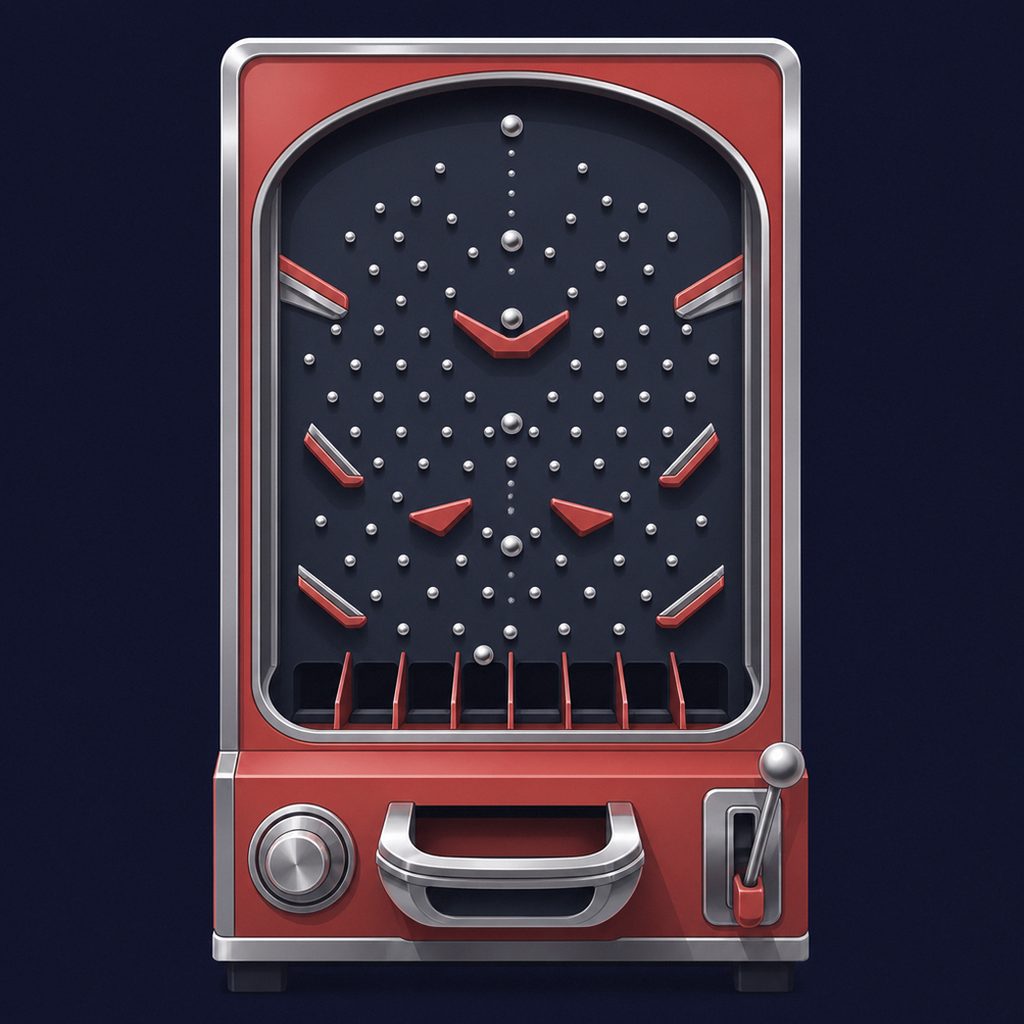
Away from the home console, an entire branch of interactive machines has lived in the grey zone between game and gamble. Arcade redemption machines dispense tickets instead of cash; Japanese pachinko and pachislot parlours occupy a legal category all their own; and coin-operated medal games let players gamble tokens that never become money. These machine traditions are crucial to understanding video game history because the companies, technologies and aesthetics behind them overlap heavily with the console industry — yet they are governed by entirely different rules. This is a historical and analytical guide to that world, not a guide to playing it.
Pachinko: Japan’s Distinctive Machine
Pachinko is a mechanical-and-electronic arcade game, unique to Japan, in which a player launches small steel balls into a vertical playing field studded with pins, gates and catchers — a descendant of the bagatelle-style pin games. Balls that fall into the right pockets win more balls. It is among the most popular pastimes in Japan and supports an enormous industry of dedicated parlours.
From Children’s Toy to Post-War Boom
The machine’s origins lie in the 1920s, when it began as a children’s amusement derived from Western pin games, before developing into an adult pastime around 1930, with Nagoya an early centre. Parlours had multiplied by the early 1940s but were shut down during the Second World War as resources were diverted. Pachinko’s defining era came in the post-war years: the first commercial parlour of the modern era is generally dated to 1948 in Nagoya, after which the pastime spread rapidly across the country and became a fixture of Japanese daily life.
The Legal Loophole
Gambling for cash is, broadly, prohibited in Japan, yet pachinko thrives. It does so through a long-standing arrangement that keeps winning and cash strictly separated. Balls won at a parlour cannot be exchanged directly for money on the premises; instead they are exchanged for “special prize” tokens (often called tokushu keihin), which the player then sells for cash at a nominally separate, off-premises vendor. Because the parlour itself never pays out cash, pachinko is treated under Japanese law as amusement rather than gambling. This separation is the single most important fact about pachinko’s status, and it explains why an activity that looks like gambling sits in a different legal box.
Pachislot: Slots Meet the Arcade
As pachinko parlours modernised, manufacturers introduced pachislot (also written pachi-slot) — Japanese slot machines that fuse the spinning reels of a Western slot machine with the parlour context and Japanese regulations. Developed and popularised from roughly the 1970s and 1980s onward, pachislot machines added skill-suggesting elements such as player-stopped reels and elaborate audiovisual presentation, while remaining within the same amusement framework as pachinko.
Pachislot is where the overlap with the video game industry becomes most visible. The machines are heavily themed, and many license popular media — anime, films, and video game franchises — for their artwork and bonus sequences. Major Japanese game companies have been directly involved: groups associated with well-known console and arcade names, including Sega Sammy and Konami, are among the significant manufacturers and license-holders for media-themed pachinko and pachislot machines. Console franchises have likewise been adapted into pachinko and pachislot cabinets, blurring the line between “video game” and “amusement machine.”
Medal Games and the Japanese Game Centre
The Japanese game centre (arcade) features medal games — coin-pusher machines, horse-racing simulations, and slot-style cabinets played with house medals rather than money. A player buys medals, plays, and may win more medals, but the medals cannot legally be exchanged for cash and cannot be removed from the venue. This keeps medal games firmly in the amusement category. They are immensely popular and form a substantial part of the arcade business, sitting alongside the video and crane games that share the same floor.
Redemption Machines: The Western Equivalent
In North America and Europe, the family arcade developed its own gamble-flavoured genre: the redemption machine. These games — skee-ball, wheel-spinners, coin-pushers and video games with a chance element — pay out tickets, which players accumulate and exchange at a prize counter for toys and novelties. The visual language is borrowed openly from gambling: spinning wheels, flashing jackpots and “big win” celebrations.
The key legal distinction is that the payout is a prize of limited value, not cash, and that many such games are marketed as amusement with prizes. Where the outcome is determined by skill, or where prize value is capped, these machines generally fall outside gambling regulation — though the precise boundaries differ by jurisdiction, and some classic coin-pusher and ticket games have at times attracted scrutiny over how much they rely on chance.
Why This Matters to Game History
The amusement-machine world is not a sideshow to video game history — it is interwoven with it. Several companies that became household names in home consoles and arcade video games also built, distributed or licensed gambling-adjacent machines, and the engineering traditions of coin-operated entertainment fed directly into the arcade game industry. The aesthetics flowed both ways: video games borrowed the jackpot-and-reward grammar of slot machines, while pachinko and pachislot borrowed characters and presentation from video games.
Understanding this branch also clarifies the modern loot-box debate. The questions regulators asked about randomised digital rewards — what is staked, whether chance governs the outcome, and whether anything of real value can be won — are the same questions that have long defined where pachinko, medal games and redemption machines sit relative to gambling law. The digital debate is, in a sense, the latest chapter of a much older legal conversation about machines and chance.
Legacy
Pachinko, pachislot, medal games and redemption machines together form a vast, durable culture of machine-based play that has run parallel to the console industry for the better part of a century. Their defining trait is the careful separation of winning from cash — the legal device that keeps them classified as amusement. For how these themes appear inside home games, see gambling in video games and the history of casino video games; for the modern digital question of randomised rewards, see loot boxes and gacha; and for the broader story of the hardware, see the history of video game consoles.
Frequently Asked Questions
What is pachinko?
Pachinko is a Japanese arcade machine in which a player launches small steel balls into a vertical pin-studded field; balls that land in the right pockets win more balls. It descends from bagatelle-style pin games and is one of Japan's most popular pastimes.
Is pachinko legal gambling in Japan?
Pachinko is treated as amusement rather than gambling because parlours never pay out cash directly. Balls are exchanged for 'special prize' tokens, which players then sell for cash at a nominally separate, off-premises vendor. This separation of winning from cash is the basis of its legal status.
What is pachislot?
Pachislot is a Japanese slot machine that combines spinning reels with the parlour context and regulations of pachinko. Popularised from roughly the 1970s-1980s, the machines are heavily themed and often license anime, films and video game franchises.
What are redemption machines?
Redemption machines are arcade games that pay out tickets rather than cash. Players accumulate tickets and exchange them for prizes at a counter. They use the visual language of gambling but are generally classified as amusement-with-prizes because the payout is a limited-value prize, not money.
What are medal games?
Medal games are coin-operated machines, common in Japanese arcades, played with house medals rather than money. Players can win more medals, but medals cannot be exchanged for cash or removed from the venue, which keeps them in the amusement category.
How are pachinko and video games connected?
Several major Japanese game companies, including groups associated with Sega Sammy and Konami, are significant manufacturers or license-holders of media-themed pachinko and pachislot machines, and a number of video game franchises have been adapted into pachinko cabinets.