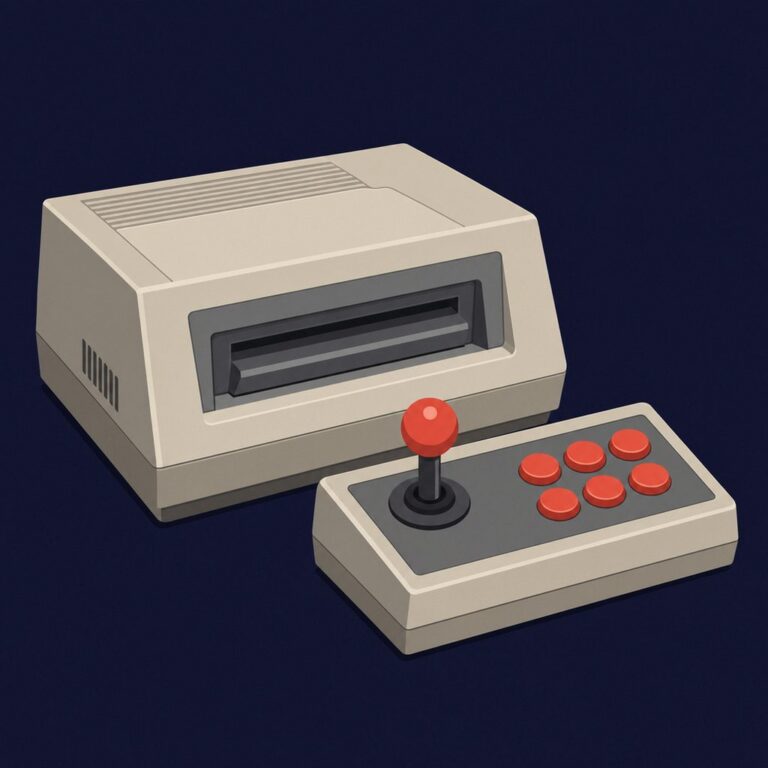
The Capcom CPS Changer is one of the rarest and most unusual home consoles ever produced. Released in 1994 at a retail price of approximately $399 USD, it was Capcom’s bold attempt to bring genuine arcade hardware into the living room — not through emulation or scaled-down ports, but by playing the actual CPS1 (Capcom Play System 1) arcade boards that powered game centers worldwide. With only 11 games ever released and an extremely limited production run, the CPS Changer was a commercial footnote in the 1990s console wars. Today, it stands as one of the most coveted pieces of gaming hardware for serious collectors.
Origins and Release
By the early 1990s, Capcom had established itself as one of the most dominant forces in the arcade industry. The CPS1 arcade system, introduced in 1988, powered a generation of iconic titles including Street Fighter II, Final Fight, and Ghouls ‘n Ghosts. The CPS1 architecture was built around a Motorola 68000 CPU running at 10 MHz, paired with Capcom’s custom CPS-A and CPS-B graphics processors. It was a proven, reliable platform that arcade operators trusted and players loved.
Capcom watched as SNK found success with the Neo Geo AES, which launched in 1990 and offered arcade-perfect gaming at home by using the same hardware and cartridges as the MVS arcade cabinets. The concept was straightforward: if players wanted the authentic arcade experience, give them the actual arcade hardware in a home-friendly package. Capcom decided to follow a similar path with the CPS Changer, adapting their CPS1 system for consumer use.
The CPS Changer launched in Japan in 1994, with a limited release following in North America. Unlike the Neo Geo, which received broad marketing and multi-year retail support, Capcom treated the CPS Changer as a niche product from the start. Distribution was limited, advertising was minimal, and the console never reached European markets. Capcom appeared to view the device as a premium offering for dedicated arcade enthusiasts rather than a mass-market product.
The Game Library
The CPS Changer’s library consists of exactly 11 titles, all drawn from Capcom’s CPS1 arcade catalog. While small in number, the lineup includes several all-time classics that defined the fighting game and beat-em-up genres during the early 1990s.
Street Fighter II: The World Warrior was the flagship title and the primary reason most buyers purchased the system. This was not a console port — it was the genuine arcade version running on authentic CPS1 hardware. The experience was identical to what players encountered in the arcade, down to the exact frame timing and audio quality. Street Fighter II’: Champion Edition followed, adding the ability to play as the four boss characters and introducing mirror matches. Street Fighter II’ Turbo: Hyper Fighting completed the Street Fighter II trilogy on the platform, delivering the faster gameplay speed and new special moves that competitive players demanded.
Final Fight, Capcom’s landmark 1989 side-scrolling beat-em-up, was another major draw. The CPS Changer version offered the complete arcade experience with all three playable characters (Cody, Guy, and Haggar) and the full six-stage campaign — unlike the SNES port, which infamously cut the character Guy and removed an entire stage due to cartridge limitations. For players who felt shortchanged by the SNES version, the CPS Changer delivered the definitive home edition.
Captain Commando (1991) brought four-player arcade action to the home, featuring its colorful cast of futuristic vigilantes fighting through a dystopian city. The King of Dragons (1991) offered a fantasy-themed beat-em-up with RPG elements including character leveling and equipment upgrades. Knights of the Round (1991), set in Arthurian legend, provided a similar experience with its three selectable knights and branching difficulty paths.
Mercs (1990), a top-down military action game and sequel to Commando, delivered intense run-and-gun gameplay. Forgotten Worlds (1988) was a side-scrolling shooter featuring the distinctive rotating satellite weapon system. Varth: Operation Thunderstorm (1992) added another vertical shooter to the lineup.
Muscle Bomber Duo (known as Saturday Night Slam Masters in North America) brought Capcom’s take on professional wrestling, combining the company’s fighting game expertise with wrestling mechanics. Nemo (1990), based on the animated film Little Nemo: Adventures in Slumberland, rounded out the library as a charming side-scrolling platformer.
Each game cartridge retailed for approximately $80 to $100, making the total cost of a complete CPS Changer collection with all 11 games somewhere in the range of $1,200 to $1,500 at original retail — a significant investment even for dedicated enthusiasts.
Hardware and Design
The CPS Changer was essentially a CPS1 arcade board repackaged for home use. Internally, it contained the same Motorola 68000 processor, CPS-A and CPS-B custom graphics chips, Yamaha YM2151 FM synthesis sound chip, and OKI MSM6295 ADPCM audio processor found in the arcade hardware. The display output supported a resolution of 384×224 pixels with up to 4,096 simultaneous colors drawn from a total palette of 65,536.
The unit itself was a compact, horizontally oriented device that accepted CPS1 cartridges through a top-loading slot. Unlike the massive arcade PCBs used in cabinets, the CPS Changer cartridges were housed in standardized plastic shells designed for easy handling — though they were still considerably larger than typical home console cartridges. The system connected to a standard television through composite video, S-Video, or RGB output, offering flexibility in display quality.
The CPS Changer’s design philosophy was similar to a supergun — a device used by arcade enthusiasts to connect JAMMA arcade boards to home televisions. However, where superguns required technical knowledge and often involved exposed circuit boards and custom wiring, the CPS Changer provided a polished, consumer-friendly experience. Everything was enclosed, self-contained, and designed for plug-and-play operation.
Capcom provided dedicated 6-button controllers with the system, featuring the same button layout used on the CPS1 arcade panels. The controller quality was decent but not exceptional — the buttons and directional pad were functional, though they lacked the premium microswitched construction of the Neo Geo AES joystick. The system supported two controller ports for head-to-head competitive play, which was essential given the fighting-game-heavy library.
Market Reception
The CPS Changer arrived at a difficult moment in gaming history. By 1994, the 16-bit era was giving way to the 32-bit generation. The PlayStation and Sega Saturn were on the horizon, promising 3D graphics and CD-ROM-based games that made 2D sprite-based systems look increasingly dated to mainstream consumers. Meanwhile, the Sega Genesis and SNES were available at a fraction of the CPS Changer’s price and offered libraries of hundreds of games.
The $399 console price placed the CPS Changer in premium territory, though it was actually more affordable than the Neo Geo AES had been at launch. However, the Neo Geo had a crucial advantage: it launched in 1990, when no home console could approach arcade-quality graphics, and it supported an ever-growing library that eventually reached 148 titles. The CPS Changer, arriving four years later with a library capped at 11 games based on aging CPS1 technology, had a far weaker value proposition.
Making matters worse, Capcom had already released the CPS2 arcade system in 1993, powering advanced titles like Super Street Fighter II Turbo, Darkstalkers, and later Marvel vs. Capcom. The CPS Changer only played CPS1 games — it was incompatible with the newer, more graphically impressive CPS2 boards. Buyers were essentially investing in hardware that Capcom had already superseded in arcades.
Capcom never disclosed production numbers, but all evidence suggests the CPS Changer was manufactured in very limited quantities. The system was discontinued by approximately 1996, having failed to establish any meaningful market presence. It remains one of the shortest-lived and least commercially successful consoles from a major manufacturer.
CPS Changer vs Neo Geo AES
The CPS Changer and Neo Geo AES represent two iterations of the same fundamental idea: bring the arcade home by using actual arcade hardware. Comparing the two systems reveals why SNK succeeded where Capcom struggled.
The Neo Geo AES launched in 1990 at $649.99 — significantly more expensive than the CPS Changer’s $399 price tag. However, the Neo Geo offered a vastly larger and continuously expanding game library, eventually reaching 148 AES titles spanning fighting games, shooters, sports games, and action titles. The CPS Changer’s 11 games could not compete in terms of variety or long-term appeal.
Technically, the two systems were remarkably similar. Both used the Motorola 68000 as their main CPU, though the Neo Geo clocked it at 12 MHz versus the CPS Changer’s 10 MHz. Both excelled at 2D sprite rendering and featured Yamaha-based sound hardware. The Neo Geo had a slight edge in sprite handling capabilities and supported larger cartridge sizes (up to 716 Mbit vs. the CPS Changer’s 40 Mbit), which allowed for more detailed graphics and animations in later titles.
Where the Neo Geo truly outclassed the CPS Changer was in commitment and longevity. SNK designed the Neo Geo as a unified arcade-and-home platform from day one, with new games releasing regularly across both the MVS arcade format and AES home format for nearly a decade. Capcom, by contrast, treated the CPS Changer as an afterthought — a way to extract additional revenue from CPS1 boards that were being phased out of arcades. There was no roadmap, no long-term support, and no attempt to build a community around the platform.
The Neo Geo AES also benefited from superior build quality and accessories. The AES joystick controller, with its microswitched stick and clicky buttons modeled directly on the arcade cabinet layout, was a premium peripheral that enhanced the arcade-at-home experience. The CPS Changer’s bundled controllers, while functional, did not inspire the same devotion.
Legacy and Collector’s Market
The CPS Changer has undergone a dramatic transformation in perception. What was once a commercial failure and curiosity has become one of the most sought-after items in retro gaming collecting. The combination of extremely limited production, a recognizable brand name, and genuine arcade hardware has driven prices to remarkable levels.
A complete-in-box CPS Changer console routinely sells for $1,500 to $3,000+ USD on the collector’s market, with pristine examples commanding even higher premiums. Loose units without original packaging still fetch $800 to $1,500. Individual game cartridges, particularly the rarer titles, have appreciated significantly: Muscle Bomber Duo and Nemo can sell for $300 to $600+ each, while even the more common Street Fighter II variants command $150 to $300.
A complete CPS Changer collection — console plus all 11 games in original condition — is an exceptionally rare find. Complete sets have sold at auction for $5,000 to $10,000+, placing the CPS Changer in the upper tier of collectible gaming hardware alongside systems like the Neo Geo AES and the Sharp Twin Famicom.
Several factors contribute to the CPS Changer’s collector appeal. First, the extremely low production numbers ensure genuine scarcity — unlike systems that were mass-produced and later became collectible through nostalgia, the CPS Changer was always rare. Second, the system plays real CPS1 arcade boards, giving it a legitimacy and authenticity that ports and emulation cannot replicate. Third, the CPS Changer represents a unique moment in Capcom’s history — the company’s only dedicated home console, a one-time experiment never repeated.
The hardware itself has proven remarkably durable. Built with arcade-grade components designed for heavy commercial use, surviving CPS Changer units typically function perfectly decades after manufacture. The solid-state cartridge format eliminates the disc-rot and laser-degradation issues that plague optical-media consoles from the same era. For collectors, this durability means that a CPS Changer purchased today is likely to function for decades to come.
For those interested in playing CPS1 games authentically without the CPS Changer’s collector-market prices, alternatives exist. Dedicated supergun devices can connect standard CPS1 arcade boards to home televisions, and loose CPS1 boards remain relatively affordable compared to CPS Changer cartridges. Capcom has also re-released many CPS1 titles on modern platforms through various compilation packages. However, none of these alternatives carry the historical significance or collector cachet of the CPS Changer itself.
The Capcom CPS Changer stands as a fascinating footnote in console history — a system that was arguably ahead of its time in concept but behind in execution. It proved that there was an audience for arcade-quality home gaming, even at premium prices. That audience was simply too small, and the library too limited, to sustain a platform. Today, the CPS Changer is valued precisely for the qualities that doomed it commercially: its rarity, its uncompromising arcade authenticity, and its status as Capcom’s sole venture into the home console market.