
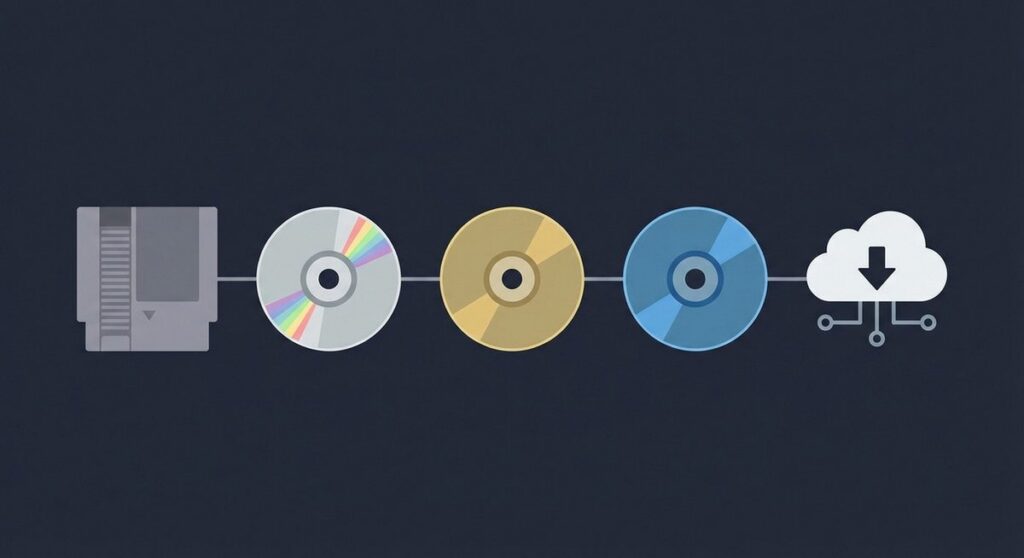
The way games are delivered to players has changed as dramatically as the games themselves. From fragile ROM cartridges to invisible digital downloads, each new media format expanded what games could be — larger worlds, better audio, cinematic cutscenes, and eventually entire libraries accessible without leaving the couch. The history of game media is a story of capacity, cost, and the eternal tension between physical ownership and digital convenience.
Hardwired Games: Before Removable Media (1972-1976)
The earliest home consoles had no removable media at all. The Magnavox Odyssey (1972), Atari Pong (1975), and dozens of dedicated Pong clones contained their games on hardwired circuits. You bought the console, you got the games it came with, and that was it. Some systems like the Odyssey used plastic overlays to create the illusion of different games, but the underlying logic never changed.
This model was inherently limited. Once consumers played through the built-in games, the console’s value evaporated. The industry needed a way to sell new software separately from the hardware.
ROM Cartridges: The First Revolution (1976-1995)
The Fairchild Channel F (1976) introduced the ROM cartridge — a plastic shell containing a read-only memory chip with game code. This was genuinely revolutionary: for the first time, a consumer electronics device could run different software by swapping a physical module. The Atari 2600 (1977) popularized the format and built an industry around it.
Cartridges had significant advantages. They were durable — no moving parts, no discs to scratch. Load times were essentially zero — the console read directly from the ROM chip. And cartridge hardware could be enhanced: the SNES used special chips like the Super FX (enabling 3D graphics in Star Fox) and the SA-1 (a co-processor that boosted performance). Nintendo’s N64 was the last major home console to use cartridges as its primary format.
The drawbacks were cost and capacity. Cartridge manufacturing was expensive — ROM chips, circuit boards, and plastic shells added up. A SNES cartridge cost $15-20 to manufacture vs. pennies for an optical disc. Storage was limited: NES carts held 8 KB to 1 MB, SNES carts up to 6 MB, N64 carts up to 64 MB. These limitations increasingly constrained game design as ambitions grew.
Handheld consoles continued using cartridges long after home consoles moved on — the Game Boy, GBA, DS, 3DS, PS Vita, and Nintendo Switch all use card-based media, benefiting from the durability and instant access that portables demand.
Optical Discs: CD-ROM, DVD, and Blu-ray (1988-2017)
The PC Engine CD-ROM² (1988) was the first console to use optical disc media, followed by the Sega CD (1991) and 3DO (1993). But it was the Sony PlayStation (1994) that made CD-ROM the industry standard. A CD held 650-700 MB — over 100 times the capacity of an N64 cartridge — at a fraction of the manufacturing cost.
CDs enabled full-motion video, voice acting, orchestral soundtracks (via Red Book CD audio), and massive game worlds. Final Fantasy VII’s three-disc epic wouldn’t have been possible on cartridges. The trade-off was load times — optical drives were slow compared to ROM access, and “Now Loading” screens became an unwelcome fixture of gaming.
The PS2 (2000) and Xbox (2001) moved to DVD, offering 4.7-8.5 GB per disc. The PS3 (2006) adopted Blu-ray at 25-50 GB per disc — a bet that helped Blu-ray win the format war against HD-DVD. The Xbox 360 stuck with DVD, occasionally requiring multi-disc releases for larger games. The Wii used proprietary DVD-based discs, while the Wii U and GameCube used proprietary optical formats with reduced capacity.
By the 2010s, even Blu-ray’s 50 GB was straining. PS4 and Xbox One games routinely required mandatory installs to the hard drive, with the disc serving primarily as a license check. The disc was becoming a delivery mechanism rather than the active game media.
Proprietary Formats and Memory Cards
Several consoles used unique media formats. The Neo Geo AES used massive cartridges identical to its arcade boards. The Game Boy line used progressively smaller cartridges. The PS Vita used proprietary memory cards that were notoriously expensive. The N-Gage infamously required removing the battery to swap game cards.
HuCards (credit-card-sized ROM cards for the TurboGrafx-16), MiniDiscs (never used for console games but proposed), and UMDs (the PSP’s proprietary optical discs) all attempted to solve the size-capacity-cost equation differently. Most proprietary formats died with their platforms.
Digital Distribution: The End of Physical Media? (2006-Present)
Digital game distribution began in earnest with Xbox Live Arcade (2005) and the PlayStation Store (2006), initially for smaller indie and retro titles. Steam (2003) had already pioneered the concept on PC. By the early 2010s, full retail games were available digitally on launch day.
The shift accelerated through the 2010s. PlayStation 4 and Xbox One offered digital versions of every retail release. Nintendo’s eShop followed. By 2020, digital sales exceeded physical sales for the first time on consoles. The PS5 Digital Edition and Xbox Series S shipped without disc drives entirely.
Digital distribution eliminated manufacturing costs, enabled instant purchases, and allowed for massive day-one patches. But it also raised concerns about ownership — digital games are licenses, not possessions. When storefronts close (as the Wii Shop Channel, 3DS eShop, and PS3/Vita stores have or nearly have), purchased games can become inaccessible. The preservation question — how do we keep games playable when digital stores disappear? — remains one of gaming’s most urgent unsolved problems.
The Future: Streaming and Beyond
Cloud gaming services like Xbox Cloud Gaming, PlayStation Now/Premium, and NVIDIA GeForce Now represent the next frontier — games running on remote servers and streamed to any device. No downloads, no physical media, no local hardware requirements beyond a screen and internet connection. Whether streaming will replace downloads the way downloads are replacing discs remains an open question, dependent on internet infrastructure that much of the world still lacks.