
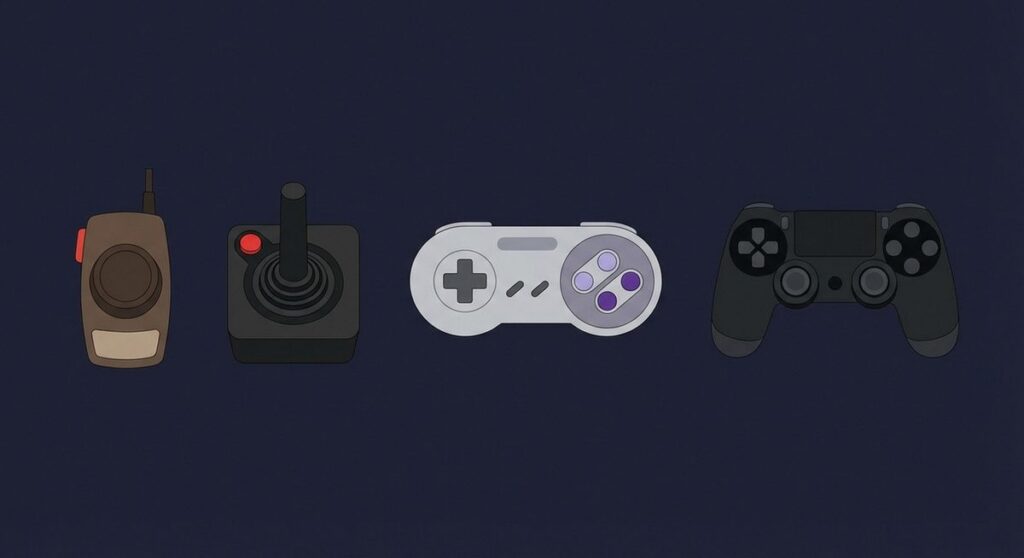
The video game controller is the bridge between player and game — the physical interface that translates human intention into on-screen action. Over five decades, controllers have evolved from single-knob paddles to precision instruments with haptic feedback, adaptive triggers, and motion sensing. Each generation’s controller innovations shaped not just how games were played, but what kinds of games were possible.
The Analog Era: Paddles, Joysticks, and Keypads (1972-1985)
The first home console controller was the Magnavox Odyssey’s paddle (1972) — two knobs controlling horizontal and vertical movement. It was primitive but functional. Atari’s paddle controllers refined the concept for Pong (1975), using a single rotary dial that became synonymous with early gaming.
The Atari 2600 joystick (1977) was the first truly iconic controller. A single stick with one fire button — simple enough for anyone to understand, versatile enough to work across hundreds of games. It established the joystick as the default controller form factor for nearly a decade.
Alternative designs proliferated. The Intellivision controller (1979) featured a 16-direction disc and 12-button keypad with game-specific overlays — ambitious but uncomfortable. The ColecoVision used a similar keypad approach. The Fairchild Channel F had triangular grip controllers that could be pushed, pulled, and twisted. The Vectrex integrated an analog joystick with four buttons — ahead of its time.
The D-Pad Revolution: NES and the Modern Gamepad (1983-1995)
Nintendo’s Famicom/NES controller (1983) changed everything. Designer Gunpei Yokoi replaced the joystick with a flat directional pad (D-pad) — a cross-shaped rocker that was cheaper, more reliable, and perfectly suited to 2D games. Combined with A and B buttons plus Start and Select, this layout became the template for every controller that followed.
The SNES controller (1990) evolved the formula with shoulder buttons (L and R) and a diamond face button layout (A, B, X, Y). Sega’s Genesis controller started with three face buttons and expanded to six for fighting games. The TurboGrafx-16 kept things simple with two buttons and turbo switches.
This era also saw ambitious experiments: the SNES Mouse for Mario Paint, the Super Scope light gun, and the Power Glove — Nintendo’s famously terrible attempt at motion control that was decades ahead of the technology needed to make it work.
The Analog Stick Era: 3D Gaming Demands New Input (1996-2005)
The shift to 3D gaming in the mid-1990s demanded new controller designs. The Nintendo 64 controller (1996) introduced the analog stick to mainstream console gaming — a thumbstick that registered degrees of pressure, enabling precise 3D movement. Its unusual three-pronged design let players grip it differently depending on the game. The N64 also introduced the Rumble Pak — the first mainstream force feedback accessory.
Sony’s DualShock (1997) refined the concept with dual analog sticks — one for movement, one for camera control — plus built-in rumble motors. This twin-stick layout became the industry standard and remains so today. The DualShock also kept the D-pad, creating a hybrid controller that worked for both 2D and 3D games.
Sega’s Dreamcast controller (1998) added a VMU (Visual Memory Unit) — a removable screen that displayed game information. Microsoft’s original Xbox controller (2001) — “The Duke” — was enormous but introduced analog triggers as standard. The smaller Controller S replacement established the template for Xbox controllers going forward.
Motion Control and Innovation (2006-2012)
The Nintendo Wii Remote (2006) was the most radical controller redesign since the D-pad. Using accelerometers and an infrared sensor bar, the Wii Remote detected motion and pointing, enabling entirely new gameplay categories. Tennis, bowling, and sword-fighting became intuitive — you swung the controller like the real thing. The Nunchuk attachment added an analog stick and additional motion sensing.
Sony responded with PlayStation Move (2010) — glowing wand controllers tracked by a camera — and Microsoft went further with Kinect (2010), eliminating the controller entirely in favor of full-body motion tracking. Both were technically impressive but struggled to find the sustained game support that made the Wii’s motion controls successful.
The Wii U GamePad (2012) embedded a 6.2-inch touchscreen into the controller, enabling asymmetric gameplay and off-TV play. It was innovative but heavy, and the concept was better realized in the Switch’s hybrid design.
The Modern Era: Precision and Feedback (2013-Present)
Modern controllers focus on refinement and sensory feedback. The Xbox Elite Controller (2015) introduced swappable components — different D-pads, thumbstick heights, and back paddles — plus adjustable trigger sensitivity. It established the premium controller category.
Sony’s DualSense (2020) brought haptic feedback and adaptive triggers to the PS5. Haptic feedback replaced simple rumble with nuanced vibrations — you could feel rain, sand, or ice through the controller. Adaptive triggers provided variable resistance, simulating bowstring tension or brake pressure. These features represented the most meaningful controller innovation in years.
The Nintendo Switch Joy-Cons combined motion controls, HD rumble, an IR sensor, and the ability to function as two independent controllers or attach to a handheld screen. The Steam Deck added PC-oriented features like trackpads and back grip buttons.
What Controllers Tell Us About Gaming
Every controller innovation reflects the industry’s priorities at that moment. The D-pad prioritized precision for 2D platformers. Analog sticks solved 3D navigation. Motion controls chased mainstream accessibility. Haptic feedback deepened immersion. The controller’s evolution mirrors gaming’s evolution — from simple arcade reflexes to complex, multi-sensory experiences that engage players in ever more sophisticated ways.