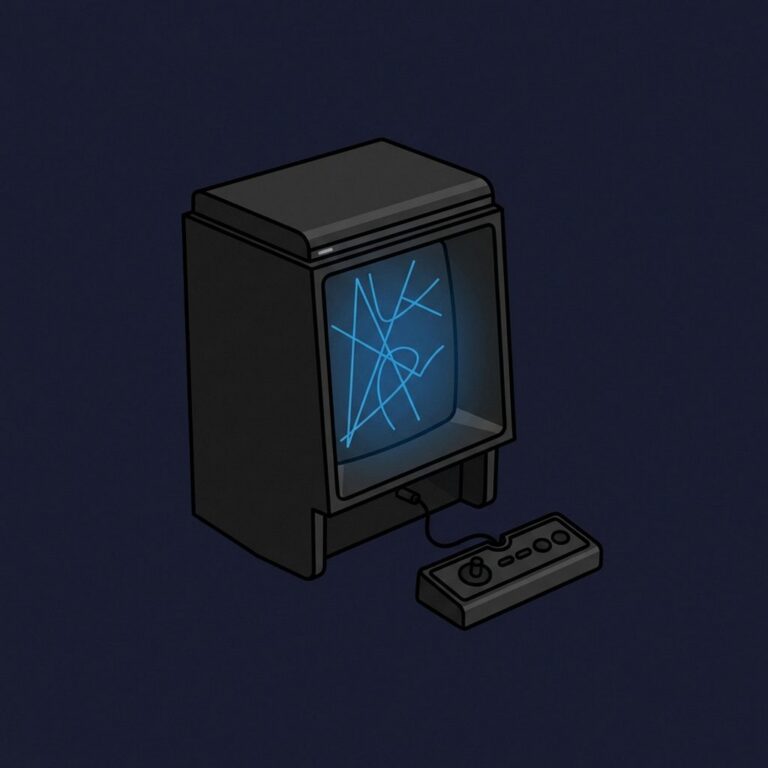
The Vectrex is a second-generation home console released in November 1982 in North America by General Consumer Electronics (GCE) at US $199. It is unique as the only home console sold with a built-in vector-graphics CRT monitor — a 9-inch black-and-white screen, with transparent plastic overlays clipped over it to simulate color.
The GCE Vectrex is the most unique home console ever produced. While every other console in history outputs to a television, the Vectrex came with its own built-in 9-inch vector CRT monitor — the same display technology used in arcade classics like Asteroids, Tempest, and Star Wars. The result was a self-contained gaming experience with razor-sharp lines, no pixel artifacts, and a visual style that remains stunning over four decades later. Released in November 1982 at the worst possible moment — months before the crash — the Vectrex sold approximately 1.5 million units before being discontinued. It is one of the most beloved and collectible consoles in gaming history.
History & Development
The Vectrex was developed by Western Technologies / Smith Engineering in Dallas, Texas, led by engineers John Ross and Jay Smith. The concept was audacious: a vector display arcade experience at home, at a time when vector monitors were expensive arcade-only technology. By integrating the monitor into the console, Smith Engineering created a product that looked and played unlike anything available for home televisions.
General Consumer Electronics (GCE) manufactured and distributed the Vectrex in North America from November 1982. Milton Bradley acquired GCE shortly after and handled European and Asian distribution. The console retailed for $199 and came bundled with Mine Storm — a built-in Asteroids-style game stored in ROM.
The timing was catastrophic. The crash of 1983 devastated the console market, and the Vectrex — as a premium, niche product — was particularly vulnerable. Milton Bradley discontinued it in 1984. Despite its short life, the Vectrex established a devoted following that persists to this day.
Hardware & Technical Specifications
The Vectrex used a Motorola MC68A09 CPU at 1.5 MHz — one of the most capable 8-bit processors available. The vector display was driven by a custom controller that directed the electron beam to draw lines directly on the phosphor-coated screen. Unlike raster displays (which scan the entire screen in rows), vector displays draw only the lines needed, producing perfectly sharp edges at any angle with no aliasing or pixel stairstepping.
The display was monochrome (white/blue phosphor), but GCE included translucent color overlays for each game that added color regions to the screen — similar to the approach used by early arcade games and the Magnavox Odyssey. The overlays also provided background artwork that the vector display couldn’t render.
Audio came from the General Instrument AY-3-8912 PSG — the same sound chip used in the ZX Spectrum, Amstrad CPC, and MSX computers — providing 3 channels plus noise. Sound quality was good for the era, delivered through the console’s built-in speaker.
Two accessories pushed the Vectrex further. The 3D Imager — a visor-like headset with spinning color discs synchronized to the display — produced genuine stereoscopic 3D and crude color effects. It was one of the first consumer 3D gaming peripherals. The light pen allowed players to draw directly on the vector screen — a natural fit for the display technology.
Game Library & Legacy
The Vectrex’s official library of 29 games is small but distinctive. Every game features the clean, sharp vector aesthetic: Star Trek: The Motion Picture (a strategic ship combat game), Armor..Attack (tank combat), Scramble (side-scrolling shooter), Berzerk (the classic arena shooter), Pole Position, and Spike (a platformer that showed the vector display could handle more than shooters).
The Vectrex homebrew scene is one of the most active in retro gaming. Modern developers continue producing new games on physical cartridges — titles like Vector Pilot, Gravitrex, and Vectrex Regeneration demonstrate that the hardware still has untapped potential. The Vectrex’s unique display technology makes every game on it feel fundamentally different from any other platform.
Collecting & Value Today
The Vectrex is a premium collectible. Working units sell for $250-400 USD without box, $400-800+ boxed. The 3D Imager accessory commands $200-400+. Games range from $20-50 for common titles to $100-300+ for rarities. The primary concern is the CRT monitor — capacitors can fail, the flyback transformer can die, and the display may develop burn-in or geometry issues. CRT repair expertise is essential for maintaining a Vectrex long-term. A working Vectrex with a healthy screen is increasingly precious as the supply of functional CRTs diminishes.
Frequently Asked Questions
Why does the Vectrex have a built-in screen?
It uses vector graphics, which need a special beam-steering CRT incompatible with raster home TVs — so bundling a dedicated monitor was the only option.
Was the Vectrex in color?
No — it is monochrome; color was simulated with a transparent plastic overlay specific to each game.
What game came with the Vectrex?
Mine Storm, an Asteroids-style vector shooter built into the system ROM (no cartridge required).
What was the Vectrex 3D Imager?
A headset using a spinning color-filter disc synced to the display for a stereoscopic 3D and pseudo-color effect — one of the earliest consumer 3D gaming peripherals.
Did the Vectrex have a light pen?
Yes — an optional light pen let you draw on-screen in titles such as Art Master and Animaction.
Why was the Vectrex discontinued?
It was killed by the North American video game crash of 1983 and pulled from the market in early 1984.