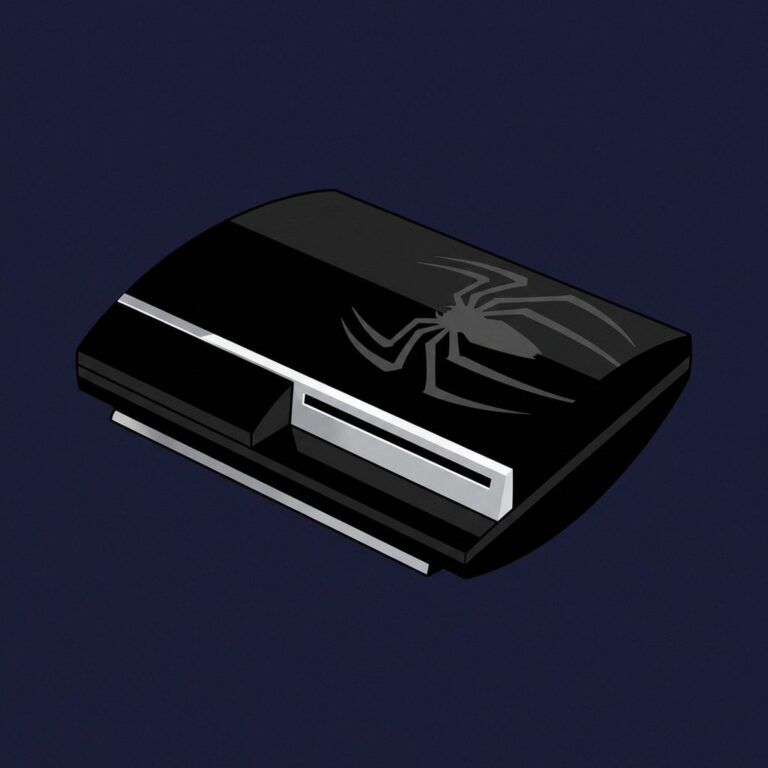
The PlayStation 3 released in Japan on November 11, 2006, North America on November 17, 2006, and Europe and other PAL regions on March 23, 2007 — the PAL launch was delayed several months by a Blu-ray diode shortage. It is a seventh-generation console.
The Sony PlayStation 3 is the story of corporate hubris, spectacular failure, and one of the greatest comebacks in console history. Launched at an outrageous $599 with an architecture so complex developers hated it, the PS3 spent its first three years being outsold by both the Xbox 360 and Wii. Sony lost an estimated $3.3 billion on the hardware. Then, slowly and relentlessly, the PS3 recovered — driven by price cuts, the PS3 Slim, an extraordinary lineup of exclusive games, and Blu-ray’s victory over HD-DVD. It finished the generation with 87.4 million units sold, essentially tying the Xbox 360 and validating Sony’s long-term strategy at an enormous short-term cost.
History & Development
The PS3’s development centered on the Cell Broadband Engine — a joint project between Sony, IBM, and Toshiba that cost an estimated $400 million to develop. The Cell was architecturally radical: a single Power Processing Element (PPE) managing seven Synergistic Processing Elements (SPEs) — specialized cores capable of extraordinary parallel computation but requiring fundamentally different programming approaches than conventional CPUs.
Sony also committed to including a Blu-ray drive — their proprietary optical disc format competing against Toshiba’s HD-DVD for the next-generation video standard. The Blu-ray drive added an estimated $100-200 to manufacturing costs, pushing the launch price to unsustainable levels.
The PS3 launched on November 11, 2006 in Japan and November 17 in North America in two configurations: $499 (20 GB) and $599 (60 GB). Sony’s then-CEO Ken Kutaragi infamously said consumers would “work more hours to buy one.” The market disagreed. Microsoft’s Xbox 360, already a year old with a growing library, was priced at $299-399. Nintendo’s Wii, launching at $249 within days of the PS3, captured the mainstream imagination with motion controls.
The PS3’s recovery began with the PS3 Slim (September 2009) at $299 — smaller, cooler, and finally hitting the price point that mass-market consumers demanded. PlayStation Plus (June 2010) offered monthly free games, building value. And Sony’s first-party studios began delivering the exclusives that justified the platform.
Hardware & Technical Specifications
The Cell’s PPE ran at 3.2 GHz with seven SPEs (six available to developers, one reserved for the OS). Each SPE had its own 256 KB local store and could process data independently. When fully utilized, the Cell was genuinely powerful — capable of physics calculations, AI processing, and computational tasks that conventional CPUs couldn’t match. But “fully utilized” was the problem: programming the Cell required managing data flow across multiple independent processors with limited local memory, a task that most developers — especially Western studios accustomed to conventional x86 architectures — found nightmarish.
The NVIDIA RSX GPU was based on the GeForce 7800 series, with 256 MB of dedicated GDDR3 alongside the Cell’s 256 MB of XDR RAM. This split memory architecture (vs. the Xbox 360’s unified 512 MB) further complicated development. Multi-platform games frequently looked and ran worse on PS3 than on Xbox 360, particularly in the console’s early years.
The Blu-ray drive provided 50 GB of storage per disc (dual-layer) — vastly more than the Xbox 360’s 8.5 GB DVDs. This capacity enabled uncompressed assets and eliminated the disc-swapping some 360 games required. The launch 60 GB model included full PS2 backward compatibility via the Emotion Engine chip — a feature removed in subsequent revisions to reduce costs.
The Sixaxis controller (launch) added motion sensing but removed the DualShock’s rumble motors due to a patent dispute with Immersion. The DualShock 3 (2007) restored rumble while keeping motion sensing, and became the standard PS3 controller.
Game Library & Legacy
The PS3’s late-generation exclusive lineup was extraordinary. Uncharted 2: Among Thieves (2009) set a new standard for cinematic action gaming. The Last of Us (2013) — Naughty Dog’s post-apocalyptic masterpiece — is widely considered one of the greatest games ever made. God of War III delivered the series’ most visually spectacular entry. Gran Turismo 5 (2010) featured 1,000+ cars. Journey (2012) was an artistic triumph. Demon’s Souls (2009) launched the Soulslike genre. LittleBigPlanet pioneered user-generated content on consoles. Metal Gear Solid 4 was a PS3 exclusive that pushed the hardware.
The PS3 was also a capable media player — Blu-ray movies, streaming apps (Netflix launched on PS3 in 2009), music playback, and web browsing. For many consumers, the PS3 was their first Blu-ray player, just as the PS2 had been their first DVD player.
Models & Variants
Three major hardware revisions: the original “fat” PS3 (CECH-Axx through CECH-Lxx, distinguished by varying levels of PS2 compatibility and hard drive sizes), the PS3 Slim (CECH-2000, September 2009, 33% smaller), and the PS3 Super Slim (CECH-4000, September 2012, top-loading disc mechanism). The original 60 GB model with full PS2 hardware compatibility is the most sought-after variant for collectors.
Collecting & Value Today
Standard PS3 consoles are very affordable at $50-100 USD. The original 60 GB with PS2 backward compatibility commands a premium at $150-250+. Games are generally cheap — most under $10. Notable exceptions include Demon’s Souls (black label), Puppeteer, Folklore, and several JRPG rarities at $40-80+. The PS3’s biggest reliability concern is the Yellow Light of Death (YLOD) — a GPU solder failure that affected early fat models. The Slim and Super Slim are significantly more reliable.
Frequently Asked Questions
When did the PS3 come out?
November 11, 2006 in Japan, November 17, 2006 in North America, and March 23, 2007 in Europe and other PAL regions.
Why did Europe get the PS3 later?
Sony delayed the PAL launch to March 2007 due to a shortage of the blue-laser diodes used in the Blu-ray drive.
What CPU does the PS3 use?
The Cell Broadband Engine at 3.2 GHz — one PowerPC PPE core plus seven SPEs — co-developed by Sony, IBM and Toshiba.
How much did the PS3 cost at launch?
$499.99 for the 20 GB model and $599.99 for the 60 GB model in the US — notably high, which hurt early adoption.
How many PS3 units were sold?
About 87.4 million lifetime, as of March 31, 2017.
Was the PS3 the first Blu-ray console?
Yes — the first console to use Blu-ray as its primary format, which helped Blu-ray win the format war over HD DVD.