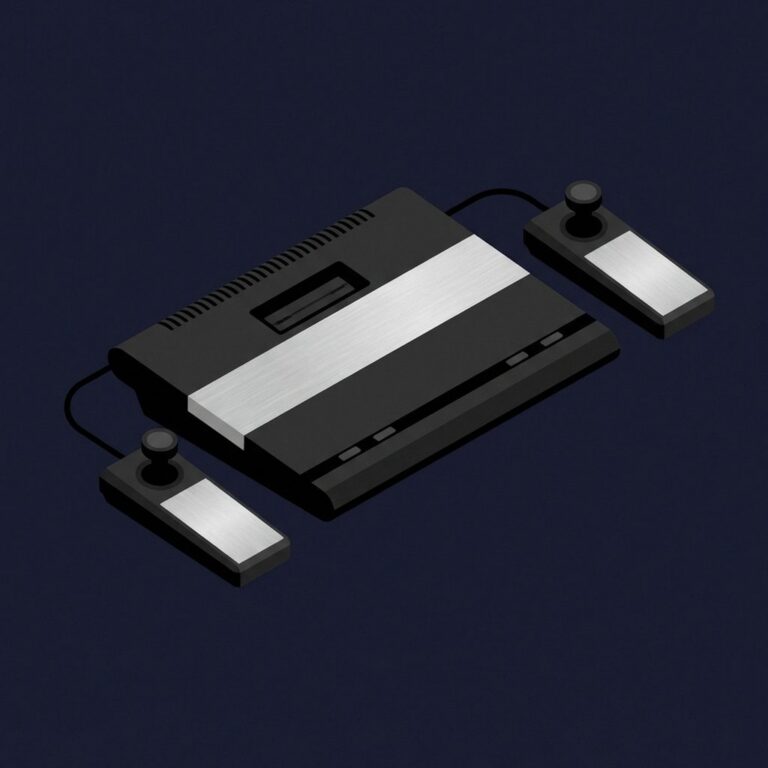
The Atari 7800 ProSystem is one of gaming’s greatest what-ifs. Designed in 1984 as a direct response to the NES, it offered strong arcade-quality graphics and full backward compatibility with the Atari 2600’s enormous library. But corporate chaos — Atari’s sale to Jack Tramiel, a two-year release delay, and a complete failure to secure third-party support — meant the 7800 arrived in 1986 to a market Nintendo had already conquered. It sold approximately 3.77 million units — respectable, but a fraction of the NES’s dominance.
History & Development
The 7800 was developed by General Computer Corporation (GCC) — the same company that created Ms. Pac-Man — under contract to Atari in 1983-1984. GCC designed the MARIA custom graphics chip specifically for sprite-heavy arcade ports, and the console was test-marketed in southern California in June 1984 to positive response.
Then everything stopped. Warner Communications sold Atari’s consumer division to Jack Tramiel (former Commodore CEO) in July 1984. Tramiel’s Atari Corp focused on computers, not consoles, and shelved the 7800 for two full years. When Nintendo’s NES proved that the console market had recovered, Tramiel finally released the 7800 nationally in May 1986 at $139.95 — but without having secured licensing agreements with third-party publishers. The NES had been on the market for months, and Nintendo’s strict licensing practices locked most publishers into exclusivity.
Hardware & Technical Specifications
The MARIA graphics chip was the 7800’s highlight. It could display up to 100 sprites per scanline (vs. the NES’s 8) with up to 256 colors in its most advanced display mode. This made it technically superior to the NES for sprite-heavy games — particularly arcade ports with many on-screen objects. The Atari SALLY CPU (a modified 6502C at 1.79 MHz) was comparable to the NES’s Ricoh 2A03.
The 7800’s critical weakness was audio. To maintain 2600 backward compatibility, Atari used the same TIA sound chip from the 2600 — producing the same crude, two-channel audio from 1977. An optional POKEY chip could be included in game cartridges for enhanced sound (as in Ballblazer and Commando), but few developers utilized it due to the added cost. The result was a console with excellent graphics but tinny, primitive audio that compared poorly to the NES’s superior sound capabilities.
2600 backward compatibility was seamlessly implemented — insert a 2600 cartridge and the 7800 played it perfectly. This gave the 7800 an instant library of hundreds of games, though the 2600 library was aging by 1986.
Game Library & Legacy
The 7800’s official library of 59 games was heavily weighted toward arcade ports — its strength. Pole Position II, Joust, Robotron: 2084, Galaga, Dig Dug, Centipede, Ms. Pac-Man, and Xevious were all excellent conversions that showcased MARIA’s sprite capabilities. Food Fight and Commando were highlights.
The library lacked depth outside arcade ports. Without major third-party support, the 7800 missed the RPGs, platformers, and action-adventures that defined the NES era. No Mega Man, no Castlevania, no Final Fantasy — the 7800 was an arcade machine in a market that was moving toward deeper, longer gaming experiences.
The 7800 has experienced a strong homebrew renaissance. Modern developers have created new games that fully exploit MARIA’s capabilities, producing titles that look genuinely impressive for an 8-bit console.
Collecting & Value Today
The 7800 is affordable to collect. Working consoles sell for $50-100 USD. Most games are in the $5-20 range. Rarer titles like Midnight Mutants, Ninja Golf, and Basketbrawl can reach $30-80. The console is extremely durable — solid-state construction with no moving parts. Its 2600 compatibility makes it an excellent two-in-one collecting platform.