
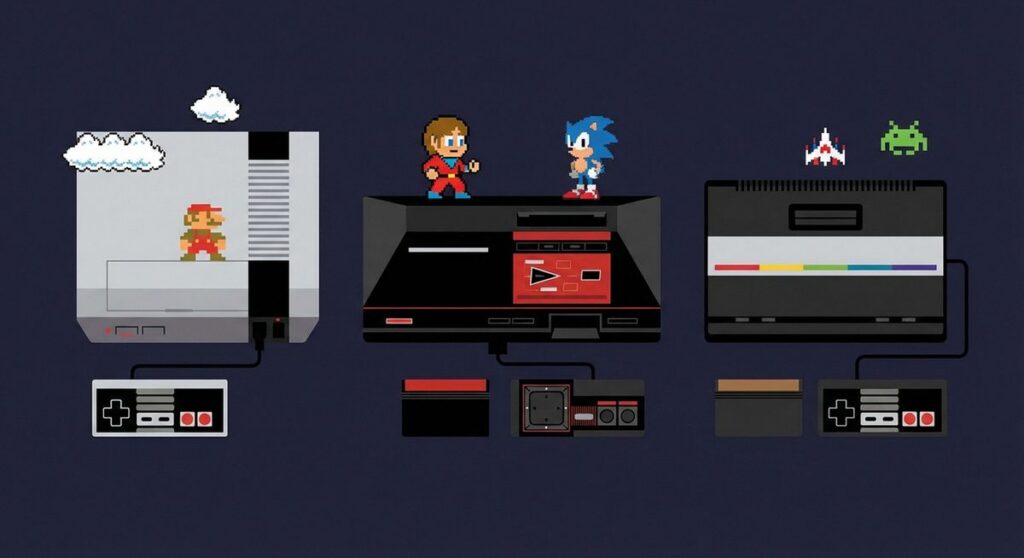
The 1980s were the most turbulent decade in video game history. The industry soared to unprecedented heights, crashed so hard that many declared home gaming dead, then rose again stronger than before. It was a decade that began with Atari as king, ended with Nintendo as emperor, and saw Sega emerge as the challenger that would ignite the fiercest rivalry gaming had ever known.
1980-1982: The Golden Age Peaks
The early 1980s were a gold rush. The Atari 2600’s success — supercharged by the 1980 home port of Space Invaders, which quadrupled console sales — proved that home video gaming was a massive market. Revenue exploded, reaching an estimated $3.2 billion in North America by 1983. Everyone wanted in.
New hardware arrived rapidly. The Mattel Intellivision (widely available from 1980) offered superior graphics and the first sports games with licensed team names. The ColecoVision (1982) delivered near-arcade-quality ports, launching with a version of Donkey Kong that embarrassed Atari’s own attempt. The GCE Vectrex (1982) took a radically different approach — it included its own built-in vector monitor, producing sharp, glowing lines reminiscent of arcade classics like Asteroids and Tempest. The Vectrex remains one of the most unique consoles ever designed.
The Atari 5200 SuperSystem (1982) was Atari’s premium follow-up, based on the Atari 400/800 computer architecture. It offered significantly better graphics and sound than the 2600 but was plagued by a notoriously unreliable analog joystick that didn’t self-center and broke frequently. The 5200 also lacked backward compatibility with the 2600’s enormous library — a critical misstep. It sold just 1 million units.
The Emerson Arcadia 2001 (1982) attempted to compete on price but arrived with a weak library. The Entex Adventure Vision (1982) was an early attempt at portable/tabletop gaming with a unique spinning-mirror LED display. These and other entries crowded the market with incompatible platforms, each demanding consumer investment in hardware and software.
1983: The Crash
The North American video game crash of 1983 was devastating. Multiple factors converged to collapse the market:
Oversaturation of low-quality software. The 2600’s open architecture and Atari’s inability (or unwillingness) to control third-party publishing led to a flood of poorly made games. Companies with no game development experience rushed products to market. The most infamous example — Atari’s E.T. the Extra-Terrestrial, developed in just five weeks to meet a holiday deadline — became the symbol of the crash. Millions of unsold E.T. cartridges were buried in a New Mexico landfill (confirmed by a 2014 excavation).
Too many competing platforms. Consumers faced a bewildering array of incompatible consoles, each with its own game library. The market couldn’t sustain this fragmentation.
Rising home computer competition. The Commodore 64 (1982, priced at $595 and falling rapidly) offered gaming capabilities alongside productivity software, undercutting the value proposition of dedicated game consoles. Jack Tramiel’s aggressive Commodore pricing strategy was specifically designed to destroy the game console market.
Industry revenues cratered from $3.2 billion in 1983 to approximately $100 million by 1985. Major retailers refused to stock video game products. Atari, once valued at $2 billion, was split up and sold. Warner Communications hemorrhaged losses. The consensus in the American business press was clear: home video gaming was a fad, and the fad was over.
1983-1985: Japan Steps In
The crash was primarily a North American phenomenon. In Japan, the market remained healthy, and two companies were building the consoles that would define the decade.
Nintendo released the Family Computer (Famicom) in Japan on July 15, 1983. Designed by Masayuki Uemura, the red-and-white console sold for ¥14,800 and used cartridges with a 60-pin connector. After an initial recall (a faulty chip caused freezing), the Famicom exploded in popularity. By 1985, it dominated the Japanese market with hits like Super Mario Bros., which sold over 6.8 million copies in Japan alone.
Sega launched the SG-1000 in Japan on the same day as the Famicom — July 15, 1983. Built around the Zilog Z80 CPU and Texas Instruments TMS9918 VDP, the SG-1000 was technically comparable to the ColecoVision. It evolved through the SG-1000 II (1984) and the Sega Mark III (1985) before being redesigned and exported as the Sega Master System. While the SG-1000 couldn’t compete with the Famicom in Japan, it established Sega’s hardware division and provided the foundation for everything that followed.
1985-1986: The NES Resurrection
Nintendo’s plan to bring the Famicom to North America required overcoming massive resistance. American retailers, burned by the crash, wanted nothing to do with video games. Nintendo’s solution was a masterclass in rebranding.
The Famicom was redesigned as the Nintendo Entertainment System (NES) — the name deliberately avoiding the word “game.” The front-loading cartridge mechanism made it resemble a VCR. R.O.B. (Robotic Operating Buddy) was included to make the package look like a toy robot rather than a game console. Nintendo tested the market in New York City during the 1985 holiday season, offering full buy-back guarantees to nervous retailers. The test succeeded, and the NES rolled out nationally in February 1986.
The NES didn’t just revive the console market — it rebuilt it under Nintendo’s strict control. The 10NES lockout chip prevented unauthorized cartridges from running. Third-party publishers signed licensing agreements limiting their annual releases and granting Nintendo manufacturing control. The Nintendo Seal of Quality told consumers that games had met minimum standards. These measures prevented a repeat of the Atari-era software flood and gave Nintendo enormous power over the industry.
The Sega Master System launched in North America in 1986 at $200. Technically superior to the NES with better color capabilities and smoother scrolling, the Master System couldn’t overcome Nintendo’s third-party stranglehold — most publishers had signed exclusive NES deals. The Master System found its audience in Europe (where it outsold the NES in several markets) and Brazil (where Tectoy manufactured and supported it well into the 2000s), but in North America and Japan, Nintendo was effectively a monopoly.
1986-1987: Late 8-Bit Entries
Several more consoles arrived in the mid-to-late 1980s, though most struggled against Nintendo’s dominance:
The Atari 7800 ProSystem (1986) was actually designed in 1984 but delayed by Atari’s corporate upheaval. It offered backward compatibility with the 2600 library — a genuine selling point — and capable graphics, but its third-party library was thin. Atari sold it at $149, undercutting the NES, and moved approximately 3.77 million units. The 7800 was the last Atari console to achieve meaningful market presence.
The Bit Corporation Dina 2-in-1 (1986) was a budget Taiwanese clone compatible with both ColecoVision and SG-1000 cartridges, sold in the US for just $40.
The Atari XE Game System (XEGS) (1987) was essentially a repackaged Atari 65XE computer sold as a game console, compatible with the Atari 8-bit computer software library. It was Atari’s confused attempt to straddle the console and computer markets and satisfied neither audience.
1987-1989: The 16-Bit Era Begins
While the NES still dominated, the next generation was already emerging.
NEC launched the PC Engine in Japan in October 1987, the first console of the 16-bit era (though it used an 8-bit CPU with a 16-bit graphics processor). Barely larger than a CD case, the PC Engine packed impressive visual capabilities into a tiny package. Its North American version, the TurboGrafx-16 (1989), struggled against the Genesis and incoming SNES but built a devoted following. The PC Engine’s CD-ROM add-on (1988) was the first successful optical media peripheral for a console, offering games with CD-quality audio, voice acting, and anime cutscenes years before the PlayStation.
The Sega Mega Drive launched in Japan on October 29, 1988, and in North America as the Sega Genesis on August 14, 1989. Powered by the Motorola 68000 CPU at 7.6 MHz — the same processor used in Sega’s arcade boards — the Genesis represented a genuine generational leap over the NES. Under the leadership of Tom Kalinske, Sega of America launched an aggressive marketing campaign directly attacking Nintendo: “Genesis does what Nintendon’t.”
The stage was set. The Genesis arrived in North America with momentum, attitude, and hardware that made NES games look ancient by comparison. Nintendo was already developing the Super Famicom, but it wouldn’t arrive in North America until August 1991. That 24-month head start gave Sega a window to build an installed base, secure third-party support, and establish the Genesis as the console for gamers who had outgrown Nintendo’s family-friendly image. The console wars — the defining rivalry of the early 1990s — had begun.
Complete List of Major 1980s Home Consoles
- 1981 — Epoch Cassette Vision, VTech CreatiVision
- 1982 — ColecoVision, Emerson Arcadia 2001, Entex Adventure Vision, GCE Vectrex, Atari 5200
- 1983 — Nintendo Famicom, Sega SG-1000, Casio PV-1000
- 1984 — Epoch Super Cassette Vision, Sega SG-1000 II
- 1985 — Nintendo NES (NA), Sega Mark III / Master System, RDI Halcyon, Daewoo Zemmix
- 1986 — Atari 7800, Bit Corp Dina, Nintendo Famicom Disk System
- 1987 — NEC PC Engine, Atari XEGS, Worlds of Wonder Action Max
- 1988 — Sega Mega Drive, NEC PC Engine CD-ROM²
- 1989 — Sega Genesis (NA), NEC TurboGrafx-16 (NA), NEC SuperGrafx, SNK Neo Geo MVS
Legacy
The 1980s compressed more drama into ten years than most industries experience in a lifetime. The decade proved that the video game market was real but fragile — vulnerable to the same oversaturation and quality failures that could sink any consumer category. It also proved that strong curation, compelling software, and smart hardware design could rebuild from the ashes. Nintendo’s rescue of the industry established the platform-holder model — hardware manufacturer as gatekeeper and ecosystem manager — that persists today. And Sega’s aggressive Genesis launch at the decade’s end set up the most exciting rivalry the industry had ever seen, one that would push both companies to creative heights throughout the 1990s.