
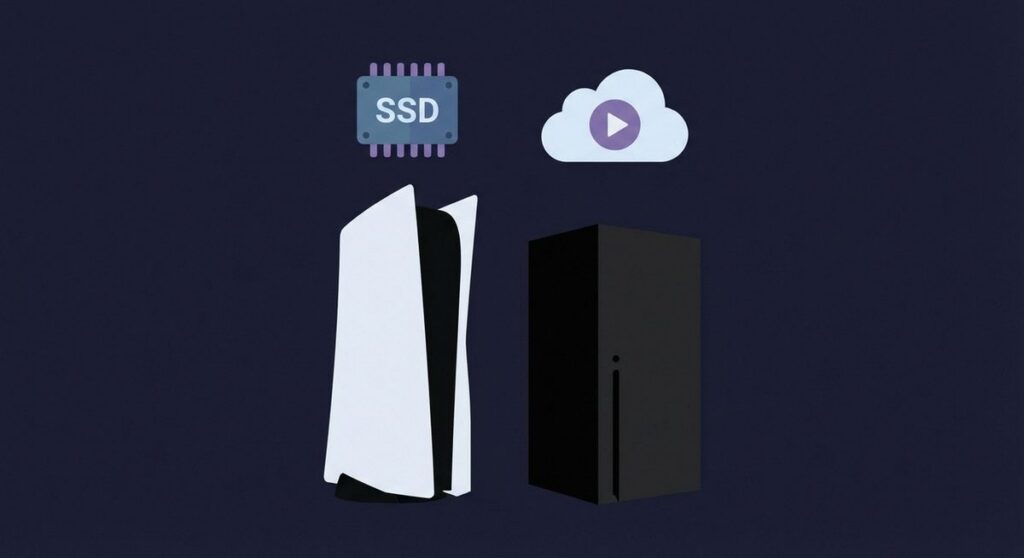
The 2020s opened with a pandemic, a chip shortage, and two new consoles nobody could buy. The PlayStation 5 and Xbox Series X|S launched within 48 hours of each other in November 2020, representing the most powerful console hardware ever produced — but semiconductor supply constraints meant millions of consumers couldn’t purchase one for over a year. Meanwhile, Valve’s Steam Deck created an entirely new product category, subscription gaming became the dominant business model debate, and the largest acquisition in entertainment history reshaped the competitive landscape.
The 9th Generation Launch
The Xbox Series X|S arrived on November 10, 2020, followed by the PS5 on November 12. Both featured AMD Zen 2 CPUs and RDNA 2 GPUs — the first time competing consoles shared the same underlying architecture. The Series X offered marginally higher raw TFLOPS (12.15 vs. 10.28), while the PS5 countered with a faster SSD (5.5 GB/s vs. 2.4 GB/s) and the innovative DualSense controller.
The COVID-19 pandemic created unprecedented demand for gaming hardware as home entertainment became essential. Simultaneously, a global semiconductor shortage — caused by pandemic-related factory shutdowns, booming demand for electronics, and cryptocurrency mining — severely constrained console production. Both PS5 and Xbox Series X were virtually impossible to buy at retail price throughout 2021. Scalper markets thrived, with consoles reselling at $700-1,000+.
The Game Pass Revolution
Microsoft’s Xbox Game Pass became the decade’s most influential business model innovation. With first-party titles launching day-one on the service (including Starfield, Forza Horizon 5, and every Bethesda and Activision Blizzard release going forward), Game Pass offered a value proposition that fundamentally challenged the traditional $70 game purchase model. By 2024, Game Pass had over 34 million subscribers.
Sony responded by restructuring PlayStation Plus into three tiers (Essential, Extra, Premium) in June 2022. Unlike Game Pass, Sony does not release first-party games day-one on the service, arguing that the model undermines the perceived value of premium games. The philosophical divide — Microsoft betting on subscription volume, Sony betting on premium exclusives — defines the decade’s competitive dynamic.
The Activision Blizzard Acquisition
Microsoft’s $68.7 billion acquisition of Activision Blizzard (announced January 2022, completed October 2023) was the largest deal in gaming history and one of the largest in entertainment. It brought Call of Duty — the best-selling annual franchise in gaming — under the Xbox umbrella, along with World of Warcraft, Diablo, Overwatch, Candy Crush, and thousands of employees across studios worldwide. The deal faced extensive regulatory scrutiny from the FTC, European Commission, and UK’s CMA before approval. Its long-term impact on platform exclusivity and competition remains the decade’s defining question.
The Rise of Handheld PCs
The Valve Steam Deck (February 2022) proved that portable PC gaming was commercially viable, estimated to have sold approximately 5 million units within two years. Running the full Steam library on a handheld device via SteamOS and the Proton compatibility layer, the Steam Deck created a new product category that immediately attracted competitors: ASUS ROG Ally, Lenovo Legion Go, MSI Claw, and others. The handheld PC market barely existed before 2022; by 2025, it was a billion-dollar segment.
The Steam Deck’s success also influenced Nintendo’s approach to the Switch successor, widely expected to feature significantly more powerful hardware to compete with portable PCs while maintaining Nintendo’s hybrid form factor and exclusive software ecosystem.
Cross-Platform and the End of Exclusivity
The 2020s have seen the traditional console exclusivity model erode significantly. Sony began releasing first-party titles on PC — God of War, Horizon Zero Dawn, Spider-Man, The Last of Us Part I — generating substantial additional revenue from a market it previously ignored. Microsoft went further, releasing Xbox exclusives on PlayStation and Nintendo platforms. Nintendo remains the last holdout, keeping its first-party titles exclusively on Nintendo hardware.
The practical result for consumers is that owning a single platform provides access to more games than ever before, while the “must-have exclusive” that drives console purchases is increasingly rare. Whether this trend ultimately benefits or harms the console market is the 2020s’ unresolved question.
The Decade So Far
As of early 2026, the PS5 leads the generation with 65+ million units sold, the Xbox Series X|S has moved approximately 30 million, and the Switch continues selling at 143+ million as it enters its final years. The gaming industry generates over $180 billion annually. The decade’s legacy is still being written, but its themes are clear: subscriptions over ownership, platforms over hardware, consolidation over competition, and the ever-blurring line between console, PC, and mobile gaming.